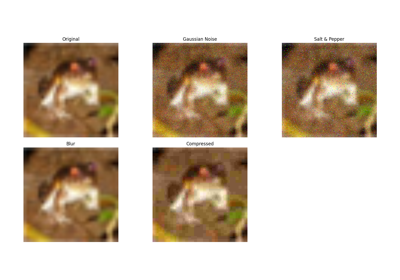
kaira.metrics.image.PeakSignalNoiseRatio
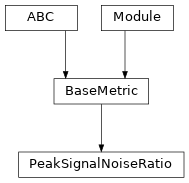
Inheritance diagram for PeakSignalNoiseRatio
- class kaira.metrics.image.PeakSignalNoiseRatio(data_range: float = 1.0, reduction: str | None = None, *args: Any, **kwargs: Any)[source]
Bases:
BaseMetricPeak Signal-to-Noise Ratio (PSNR) Module.
PSNR measures the ratio between the maximum possible power of a signal and the power of corrupting noise that affects the quality of its representation. Higher values indicate better quality [Hore and Ziou, 2010]. While PSNR doesn’t perfectly correlate with human perception, it is widely used for its simplicity and clear physical meaning [Wang and Bovik, 2009].
Methods
Initialize the PeakSignalNoiseRatio module.
Compute PSNR with mean and standard deviation.
Calculate PSNR between predicted and target images.
Examples using
kaira.metrics.image.PeakSignalNoiseRatio
Original DeepJSCC Model (Bourtsoulatze 2019) with Training
Original DeepJSCC Model (Bourtsoulatze 2019) with Training
Deep Joint Source-Channel Coding (DeepJSCC) Model - Bourtsoulatze2019 Implementation
Deep Joint Source-Channel Coding (DeepJSCC) Model - Bourtsoulatze2019 Implementation- __init__(data_range: float = 1.0, reduction: str | None = None, *args: Any, **kwargs: Any) None[source]
Initialize the PeakSignalNoiseRatio module.
- Parameters:
data_range (float) – The range of the input data (typically 1.0 or 255)
reduction (Optional[str]) – Reduction method. The underlying torchmetrics implementation requires reduction=None, so this parameter controls post-processing reduction.
*args – Variable length argument list passed to the base class and torchmetrics.
**kwargs – Arbitrary keyword arguments passed to the base class and torchmetrics.
- forward(x: Tensor, y: Tensor, *args: Any, **kwargs: Any) Tensor[source]
Calculate PSNR between predicted and target images.
- Parameters:
x (Tensor) – Predicted images
y (Tensor) – Target images
*args – Variable length argument list (currently unused).
**kwargs – Arbitrary keyword arguments (currently unused).
- Returns:
PSNR values for each sample or reduced according to reduction parameter
- Return type:
Tensor
- compute_with_stats(x: Tensor, y: Tensor, *args: Any, **kwargs: Any) Tuple[Tensor, Tensor][source]
Compute PSNR with mean and standard deviation.
- Parameters:
x (Tensor) – Predicted images
y (Tensor) – Target images
*args – Variable length argument list (currently unused).
**kwargs – Arbitrary keyword arguments (currently unused).
- Returns:
Mean and standard deviation of PSNR values
- Return type:
Tuple[Tensor, Tensor]