kaira.channels.NonlinearChannel
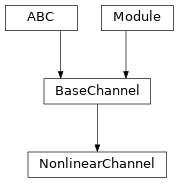
Inheritance diagram for NonlinearChannel
- class kaira.channels.NonlinearChannel(nonlinear_fn, add_noise=False, avg_noise_power: float | None = None, snr_db: float | None = None, complex_mode='direct', *args: Any, **kwargs: Any)[source]
Bases:
BaseChannelGeneral nonlinear channel with configurable transfer function.
Models various nonlinear effects by applying a user-specified nonlinear function to the input signal, optionally followed by additive noise. Handles both real and complex-valued signals. Common nonlinear models include the Saleh model for traveling-wave tube amplifiers [Saleh, 1981].
- Mathematical Model:
y = f(x) + n where f is a nonlinear function and n is optional noise
- Parameters:
nonlinear_fn (callable) – A function that implements the nonlinear transformation
add_noise (bool) – Whether to add noise after the nonlinear operation
avg_noise_power (float, optional) – The average noise power if add_noise is True
snr_db (float, optional) – SNR in dB (alternative to avg_noise_power)
complex_mode (str, optional) – How to handle complex inputs: ‘direct’ (default) passes the complex signal directly to nonlinear_fn, ‘cartesian’ applies the function separately to real and imaginary parts, ‘polar’ applies to magnitude and preserves phase
Example
>>> # Create a channel with cubic nonlinearity for real signals
>>> channel = NonlinearChannel(lambda x: x + 0.2 * x**3)
>>> x = torch.linspace(-1, 1, 100)
>>> y = channel(x)  # Output with cubic distortion
>>> # For complex signals, using polar mode (apply nonlinearity to magnitude only)
>>> def mag_distortion(x): return x * (1 - 0.1 * x)  # compression
>>> channel = NonlinearChannel(mag_distortion, complex_mode='polar')
>>> x = torch.complex(torch.randn(100), torch.randn(100))
>>> y = channel(x)  # Output with magnitude distortion, phase preserved
Methods
Initialize the Nonlinear channel.
Apply the nonlinear function and optional noise to the input signal.
Get a dictionary of the channel's configuration.
Attributes
- get_config() Dict[str, Any]
Get a dictionary of the channel’s configuration.
This method returns a dictionary containing the channel’s parameters, which can be used to recreate the channel instance.
- Returns:
Dictionary of parameter names and values
- Return type:
Dict[str, Any]
- __init__(nonlinear_fn, add_noise=False, avg_noise_power: float | None = None, snr_db: float | None = None, complex_mode='direct', *args: Any, **kwargs: Any)[source]
Initialize the Nonlinear channel.
- Parameters:
nonlinear_fn (callable) – The nonlinear transformation function.
add_noise (bool) – Whether to add noise after nonlinearity.
avg_noise_power (float, optional) – Average noise power if add_noise=True.
snr_db (float, optional) – SNR in dB (alternative if add_noise=True).
complex_mode (str) – How to handle complex inputs (‘direct’, ‘cartesian’, ‘polar’).
*args – Variable length argument list passed to the base class.
**kwargs – Arbitrary keyword arguments passed to the base class.
- forward(x: Tensor, *args: Any, **kwargs: Any) Tensor[source]
Apply the nonlinear function and optional noise to the input signal.
- Parameters:
x (torch.Tensor) – The input tensor.
*args – Additional positional arguments (unused).
**kwargs – Additional keyword arguments (unused).
- Returns:
The output tensor after applying nonlinearity and noise.
- Return type: