kaira.metrics.signal.BlockErrorRate
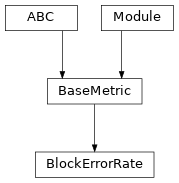
Inheritance diagram for BlockErrorRate
- class kaira.metrics.signal.BlockErrorRate(block_size: int | None = None, threshold: float = 0.0, reduction: str = 'mean', name: str | None = None, *args: Any, **kwargs: Any)[source]
Bases:
BaseMetricBlock Error Rate (BLER) metric.
BLER measures the number of blocks containing at least one error divided by the total number of blocks transmitted. Lower values indicate better performance. It’s commonly used in systems employing block codes [Lin and Costello, 2004].
This metric can also be used for Frame Error Rate (FER) or Symbol Error Rate (SER) by setting the block_size appropriately or leaving it as None to treat each row as a block/frame/symbol.
- total_blocks
Accumulated total number of blocks processed.
- Type:
Tensor
- error_blocks
Accumulated number of blocks with errors.
- Type:
Tensor
Methods
Initialize the BlockErrorRate module.
Compute accumulated block error rate.
Compute metric with mean and standard deviation.
Compute the Block Error Rate for the current batch.
Reset accumulated statistics.
Update accumulated statistics with results from a new batch.
Attributes
- is_differentiable = False
- higher_is_better = False
- __init__(block_size: int | None = None, threshold: float = 0.0, reduction: str = 'mean', name: str | None = None, *args: Any, **kwargs: Any) None[source]
Initialize the BlockErrorRate module.
- Parameters:
block_size (Optional[int]) – Size of each block in the input. If None, each row of the input is treated as a separate block.
threshold (float) – Threshold for considering values as different. Useful for floating-point comparisons.
reduction (str) – Reduction method: ‘mean’, ‘sum’, or ‘none’.
name (Optional[str]) – Name for the metric.
*args – Variable length argument list passed to the base class.
**kwargs – Arbitrary keyword arguments passed to the base class.
- forward(x: Tensor, y: Tensor, *args: Any, **kwargs: Any) Tensor[source]
Compute the Block Error Rate for the current batch.
- Parameters:
x (Tensor) – The predicted tensor.
y (Tensor) – The target tensor.
*args – Variable length argument list (unused).
**kwargs – Arbitrary keyword arguments (unused).
- Returns:
Block error rate for the batch, potentially reduced.
- Return type:
Tensor
- update(x: Tensor, y: Tensor, *args: Any, **kwargs: Any) None[source]
Update accumulated statistics with results from a new batch.
- Parameters:
x (Tensor) – The predicted tensor for the current batch.
y (Tensor) – The target tensor for the current batch.
*args – Variable length argument list (unused).
**kwargs – Arbitrary keyword arguments (unused).
- compute() Tensor[source]
Compute accumulated block error rate.
- Returns:
Block error rate value
- Return type:
Tensor
- compute_with_stats(x: Tensor, y: Tensor, *args: Any, **kwargs: Any) Tuple[Tensor, Tensor]
Compute metric with mean and standard deviation.
- Parameters:
x (torch.Tensor) – The first input tensor (typically predictions)
y (torch.Tensor) – The second input tensor (typically targets)
*args – Variable length argument list.
**kwargs – Arbitrary keyword arguments.
- Returns:
Mean and standard deviation of the metric
- Return type:
Tuple[torch.Tensor, torch.Tensor]