kaira.constraints.PerAntennaPowerConstraint
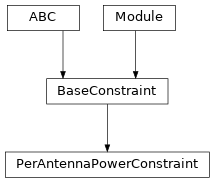
Inheritance diagram for PerAntennaPowerConstraint
- class kaira.constraints.PerAntennaPowerConstraint(power_budget: Tensor | None = None, uniform_power: float | None = None, *args, **kwargs)[source]
Bases:
BaseConstraintDistributes power budget across multiple antennas to ensure per-antenna power limits.
Ensures each antenna in a multi-antenna system (such as MIMO) adheres to its specific power budget. This constraint is crucial for systems where each antenna has its own power amplifier with individual power limitations [Yu and Lan, 2007] [Wunder et al., 2013].
Per-antenna power constraints are often more practical than sum-power constraints in real MIMO systems, as discussed in [Christopoulos et al., 2014] and [Yu and Lan, 2007].
The constraint can be configured either with individual power budgets for each antenna or with a uniform power value across all antennas.
- power_budget
Power budget tensor for each antenna
- Type:
torch.Tensor, optional
Methods
Initialize the per-antenna power constraint.
Apply per-antenna power constraint.
Helper method to get all dimensions except batch for calculating norms/means.
- __init__(power_budget: Tensor | None = None, uniform_power: float | None = None, *args, **kwargs) None[source]
Initialize the per-antenna power constraint.
- Parameters:
power_budget (torch.Tensor, optional) – Power budget for each antenna. Shape should be [num_antennas]. Mutually exclusive with uniform_power.
uniform_power (float, optional) – Uniform power value to apply across all antennas. Mutually exclusive with power_budget.
*args – Variable length argument list.
**kwargs – Arbitrary keyword arguments.
- Raises:
AssertionError – If neither power_budget nor uniform_power is provided
Note
Either power_budget or uniform_power must be provided, but not both. If power_budget is provided, its length must match the number of antennas in the input signal.
- forward(x: Tensor, *args, **kwargs) Tensor[source]
Apply per-antenna power constraint.
Scales the signal from each antenna independently to meet its power budget. The second dimension of the input tensor is assumed to be the antenna dimension.
- Parameters:
x (torch.Tensor) – Input tensor with shape [batch_size, num_antennas, …]. The second dimension must correspond to different antennas.
*args – Variable length argument list.
**kwargs – Arbitrary keyword arguments.
- Returns:
- Power-constrained signal with the same shape as input, where
each antenna’s signal has been scaled to meet its power budget
- Return type:
Note
Power is calculated by averaging the squared magnitude across all dimensions except batch and antenna dimensions.
- static get_dimensions(x: Tensor, exclude_batch: bool = True) Tuple[int, ...]
Helper method to get all dimensions except batch for calculating norms/means.
Utility function to generate dimension indices for reduction operations like mean or norm. Typically used to calculate signal properties across all dimensions except the batch dimension.
- Parameters:
x (torch.Tensor) – Input tensor
exclude_batch (bool, optional) – Whether to exclude the batch dimension (first dimension). Defaults to True.
- Returns:
Dimensions to use for reduction operations (e.g., mean, norm)
- Return type:
Tuple[int, …]
Example
>>> x = torch.randn(32, 4, 128)  # [batch, antennas, time]
>>> dims = BaseConstraint.get_dimensions(x)
>>> # dims will be (1, 2) for summing across antennas and time