kaira.models.fec.encoders.BCHCodeEncoder
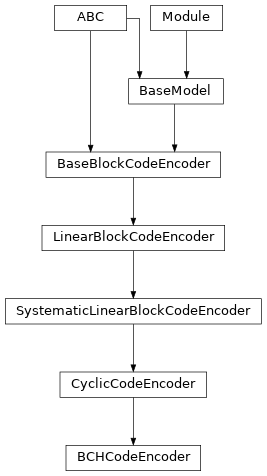
Inheritance diagram for BCHCodeEncoder
- class kaira.models.fec.encoders.BCHCodeEncoder(mu: int, delta: int, information_set: List[int] | Tensor | str = 'left', dtype: dtype = torch.float32, **kwargs: Any)[source]
Bases:
CyclicCodeEncoderEncoder for BCH (Bose–Chaudhuri–Hocquenghem) codes.
BCH codes are a class of powerful cyclic error-correcting codes that can be designed to correct multiple errors. They are constructed using polynomials over finite fields and provide great flexibility in the trade-off between redundancy and error-correcting capability [Lin and Costello, 2004, Richardson and Urbanke, 2008].
For given parameters μ ≥ 2 and δ satisfying 2 ≤ δ ≤ 2^μ - 1, a binary BCH code has the following parameters, where δ = 2τ + 1:
Length: n = 2^μ - 1
Dimension: k ≥ n - μτ
Redundancy: m ≤ μτ
Minimum distance: d ≥ δ
This implementation handles narrow-sense, primitive BCH codes [Lin and Costello, 2004, Moon, 2005, Sklar, 2001].
- Parameters:
mu (int) – The parameter μ of the code. Must satisfy μ ≥ 2.
delta (int) – The design distance δ of the code. Must satisfy 2 ≤ δ ≤ 2^μ - 1 and be a valid Bose distance.
information_set (Union[List[int], torch.Tensor, str], optional) – Information set specification. Default is “left”.
dtype (torch.dtype, optional) – Data type for internal tensors. Default is torch.float32.
**kwargs – Additional keyword arguments passed to the parent class.
Examples
>>> encoder = BCHCodeEncoder(mu=4, delta=5)
>>> print(f"Length: {encoder.length, Dimension: {encoder.dimension}, Redundancy: {encoder.redundancy}")
Length: 15, Dimension: 7, Redundancy: 8
>>> message = torch.tensor([1., 0., 1., 1., 0., 1., 0.])
>>> codeword = encoder(message)
>>> print(codeword)
tensor([1., 0., 1., 1., 0., 1., 0., 1., 0., 0., 1., 1., 0., 0., 1.])
Methods
Initialize the BCH code encoder.
Calculate the syndrome of a received word.
Calculate the syndrome polynomial for a received word.
Create a standard BCH code by name.
Encode a message polynomial into a codeword polynomial using systematic encoding.
Extract the message bits from a codeword.
Extract a message polynomial from a codeword polynomial.
Encode the input tensor using polynomial encoding.
Create a BCH code with a design rate close to the target rate.
Get a dictionary of standard BCH codes with their parameters.
Decode the input tensor using the generator matrix right inverse.
Get the minimum distance of the code.
Project a codeword onto the information set.
Attributes
Check polynomial h(X) of the code.
Get the code dimension (k).
Get the codeword length (n).
Get the rate of the code (k/n).
Design distance δ of the code.
Error correction capability of the code (t = ⌊(δ-1)/2⌋).
Generator polynomial g(X) of the code.
Either indices of information positions, which must be a k-sublist of [0...n), or one of the strings 'left' or 'right'.
Modulus polynomial X^n + 1 of the code.
Parameter μ of the code.
Get the number of parity bits (synonym for redundancy).
Get the check matrix H of the code.
Parity set M of the code.
Parity submatrix P of the code.
Get the code redundancy (r = n - k).
- __init__(mu: int, delta: int, information_set: List[int] | Tensor | str = 'left', dtype: dtype = torch.float32, **kwargs: Any)[source]
Initialize the BCH code encoder.
- Parameters:
mu – The parameter μ of the code. Must satisfy μ ≥ 2.
delta – The design distance δ of the code. Must satisfy 2 ≤ δ ≤ 2^μ - 1 and be a valid Bose distance.
information_set – Either indices of information positions, which must be a k-sublist of [0…n), or one of the strings ‘left’ or ‘right’. Default is ‘left’.
dtype – Data type for internal tensors. Default is torch.float32.
**kwargs – Additional keyword arguments passed to the parent class.
- Raises:
ValueError – If μ < 2 or if δ is not a valid Bose distance.
- minimum_distance() int[source]
Get the minimum distance of the code.
For BCH codes, the minimum distance is at least the design distance.
- Returns:
The minimum distance of the code, which is at least δ.
- classmethod from_design_rate(mu: int, target_rate: float, **kwargs: Any) BCHCodeEncoder[source]
Create a BCH code with a design rate close to the target rate.
- Parameters:
mu – The parameter μ of the BCH code.
target_rate – The target rate (k/n) of the code.
**kwargs – Additional arguments passed to the constructor.
- Returns:
A BCH code encoder with rate close to the target rate.
- Raises:
ValueError – If no suitable code can be found.
- classmethod get_standard_codes() Dict[str, Dict[str, Any]][source]
Get a dictionary of standard BCH codes with their parameters.
- Returns:
Dictionary mapping code names to their parameters.
- classmethod create_standard_code(name: str, **kwargs: Any) BCHCodeEncoder[source]
Create a standard BCH code by name.
- Parameters:
name – Name of the standard code from get_standard_codes().
**kwargs – Additional arguments passed to the constructor.
- Returns:
A BCH code encoder for the requested standard code.
- Raises:
ValueError – If the requested code is not recognized.
- calculate_syndrome_polynomial(received: List[Any]) List[Any][source]
Calculate the syndrome polynomial for a received word.
This method computes the syndrome polynomial S(x) for a received codeword by evaluating the received polynomial at powers of alpha, which are the roots of the generator polynomial.
- Parameters:
received – List of field elements representing the received word
- Returns:
List of syndrome values in the field, S = [S_0, S_1, …, S_{2t-1}]
- calculate_syndrome(x: Tensor) Tensor
Calculate the syndrome of a received word.
The syndrome is computed as s = xH^T and is used to detect errors. A non-zero syndrome indicates the presence of errors [Lin and Costello, 2004, Moon, 2005]. This approach is a fundamental technique in error detection and correction for linear block codes [Sklar, 2001].
- Parameters:
x – Received word tensor of shape (…, codeword_length) or (…, b*codeword_length) where b is a positive integer.
- Returns:
Syndrome tensor of shape (…, redundancy) or (…, b*redundancy)
- property check_poly: BinaryPolynomial
Check polynomial h(X) of the code.
- property code_dimension: int
Get the code dimension (k).
- Returns:
The number of information bits encoded in each codeword
- property code_length: int
Get the codeword length (n).
- Returns:
The number of bits in each codeword after encoding
- property code_rate: float
Get the rate of the code (k/n).
The code rate is a measure of efficiency, representing the proportion of the total bits that carry information (as opposed to redundancy).
- Returns:
The ratio of information bits to total bits (between 0 and 1)
- encode_message_polynomial(message_poly: BinaryPolynomial) BinaryPolynomial
Encode a message polynomial into a codeword polynomial using systematic encoding.
- Parameters:
message_poly – The message polynomial to encode
- Returns:
The systematically encoded codeword polynomial
- extract_message(codeword: Tensor) Tensor
Extract the message bits from a codeword.
By default, this calls inverse_encode and returns just the decoded message. Subclasses can override this method to provide more efficient implementations.
- Parameters:
codeword – Codeword tensor with shape (…, n) where n is the code length
- Returns:
Extracted message tensor with shape (…, k) where k is the code dimension
Note
This implementation assumes the inverse_encode method can handle a single codeword correctly. Specific code types may override this with more efficient implementations.
- extract_message_polynomial(codeword_poly: BinaryPolynomial) BinaryPolynomial
Extract a message polynomial from a codeword polynomial.
- Parameters:
codeword_poly – The codeword polynomial to extract from
- Returns:
The message polynomial
- forward(x: Tensor, *args: Any, **kwargs: Any) Tensor
Encode the input tensor using polynomial encoding.
For cyclic codes, encoding can be done using polynomial operations. This implementation delegates to the parent class for efficiency.
- Parameters:
x – The input tensor of shape (…, message_length) or (…, b*message_length) where b is a positive integer.
*args – Additional positional arguments (unused).
**kwargs – Additional keyword arguments (unused).
- Returns:
Encoded tensor of shape (…, codeword_length) or (…, b*codeword_length)
- property generator_poly: BinaryPolynomial
Generator polynomial g(X) of the code.
- property information_set: Tensor
Either indices of information positions, which must be a k-sublist of [0…n), or one of the strings ‘left’ or ‘right’.
Default is ‘left’.
- inverse_encode(x: Tensor, *args: Any, **kwargs: Any) Tuple[Tensor, Tensor]
Decode the input tensor using the generator matrix right inverse.
This method takes one or more sequences of codewords and returns their corresponding decoded messages along with syndromes. The decoding approach follows standard techniques in error control coding literature [Lin and Costello, 2004, Sklar, 2001].
- Parameters:
x – The input tensor. Can be either a single sequence whose length is a multiple of n, or a multidimensional tensor where the last dimension is a multiple of n.
*args – Additional positional arguments (unused).
**kwargs – Additional keyword arguments (unused).
- Returns:
Decoded tensor of shape (…, b*k). Has the same shape as the input, with the last dimension reduced from b*n to b*k, where b is a positive integer.
Syndrome tensor for error detection of shape (…, b*r), where r is the redundancy.
- Return type:
Tuple containing
- Raises:
ValueError – If the last dimension of the input is not a multiple of n.
- property modulus_poly: BinaryPolynomial
Modulus polynomial X^n + 1 of the code.
- property parity_bits: int
Get the number of parity bits (synonym for redundancy).
- Returns:
The number of parity/check bits in each codeword
- property parity_check_matrix: Tensor
Get the check matrix H of the code.
The check matrix H satisfies the property: GH^T = 0
- Returns:
The check matrix H of the code
- project_word(x: Tensor) Tensor
Project a codeword onto the information set.
This extracts the information bits directly from a codeword without decoding, which is a key advantage of systematic codes.
- Parameters:
x – Input tensor of shape (…, codeword_length) or (…, b*codeword_length) where b is a positive integer.
- Returns:
Projected tensor of shape (…, message_length) or (…, b*message_length)
- Raises:
ValueError – If the last dimension of the input is not a multiple of n.