kaira.channels.UplinkMACChannel
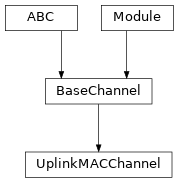
Inheritance diagram for UplinkMACChannel
- class kaira.channels.UplinkMACChannel(user_channels: BaseChannel | List[BaseChannel], num_users: int | None = None, user_gains: float | List[float] | None = None, interference_power: float = 0.0, combine_method: str = 'sum', *args: Any, **kwargs: Any)[source]
Bases:
BaseChannelUplink Multiple Access Channel (MAC) for modeling multi-user uplink communications.
This channel models uplink communication scenarios where multiple users transmit simultaneously to a single receiver. The channel uses a composition pattern, accepting existing channel implementations (e.g., FlatFadingChannel, AWGNChannel) as parameters to model different channel conditions for individual user transmissions.
The channel applies per-user channel effects, models inter-user interference, and combines the signals according to the MAC model. This enables realistic simulation of uplink scenarios with different channel conditions per user.
- Mathematical Model:
For N users, the received signal is: y = Σᵢ₌₁ᴺ hᵢ(xᵢ) + interference + noise
where hᵢ(xᵢ) is the channel response for user i’s signal xᵢ.
- Parameters:
user_channels (Union[BaseChannel, List[BaseChannel]]) – Channel instances for each user. Can be a single channel to be shared among all users, or a list of channels (one per user).
num_users (Optional[int]) – Number of users. Required if user_channels is a single channel instance. Inferred from the list length if user_channels is a list.
user_gains (Optional[Union[float, List[float]]]) – Per-user channel gains. Can be a single gain applied to all users or a list of gains (one per user). Defaults to 1.0 for all users.
interference_power (float) – Power of inter-user interference. Defaults to 0.0.
combine_method (str) – Method for combining user signals. Options: ‘sum’, ‘weighted_sum’. Defaults to ‘sum’.
Example
>>> # Using the same AWGN channel for all users
>>> from kaira.channels import AWGNChannel, UplinkMACChannel
>>> base_channel = AWGNChannel(avg_noise_power=0.1)
>>> uplink_channel = UplinkMACChannel(
...     user_channels=base_channel,
...     num_users=3,
...     user_gains=[1.0, 0.8, 0.6]
... )
>>> # Using different channels for each user
>>> from kaira.channels import FlatFadingChannel, RayleighFadingChannel
>>> user_channels = [
...     AWGNChannel(avg_noise_power=0.1),
...     FlatFadingChannel(fading_type="rayleigh", coherence_time=10, avg_noise_power=0.05),
...     RayleighFadingChannel(coherence_time=5, avg_noise_power=0.15)
... ]
>>> uplink_channel = UplinkMACChannel(user_channels=user_channels)
Methods
Initialize the UplinkMAC channel.
Apply uplink MAC channel effects to user signals.
Get a dictionary of the channel's configuration.
Get channel state information for a specific user.
Update the inter-user interference power.
Update the channel gain for a specific user.
- __init__(user_channels: BaseChannel | List[BaseChannel], num_users: int | None = None, user_gains: float | List[float] | None = None, interference_power: float = 0.0, combine_method: str = 'sum', *args: Any, **kwargs: Any)[source]
Initialize the UplinkMAC channel.
- Parameters:
user_channels (Union[BaseChannel, List[BaseChannel]]) – Channel instances for each user.
num_users (Optional[int]) – Number of users. Required if user_channels is a single channel.
user_gains (Optional[Union[float, List[float]]]) – Per-user channel gains.
interference_power (float) – Power of inter-user interference. Defaults to 0.0.
combine_method (str) – Method for combining user signals. Defaults to ‘sum’.
*args – Variable length argument list passed to the base class.
**kwargs – Arbitrary keyword arguments passed to the base class.
- forward(x: List[Tensor], *args: Any, user_csi: List[Tensor] | None = None, user_noise: List[Tensor] | None = None, **kwargs: Any) Tensor[source]
Apply uplink MAC channel effects to user signals.
- Parameters:
x (List[torch.Tensor]) – List of input signals, one per user. Each tensor should have the same shape.
*args – Additional positional arguments passed to individual channels.
user_csi (Optional[List[torch.Tensor]]) – Per-user channel state information. If provided, should be a list of CSI tensors (one per user).
user_noise (Optional[List[torch.Tensor]]) – Per-user noise tensors. If provided, should be a list of noise tensors (one per user).
**kwargs – Additional keyword arguments passed to individual channels.
- Returns:
- Combined received signal after applying channel effects
and inter-user interference.
- Return type:
- Raises:
ValueError – If the number of input signals doesn’t match num_users.
ValueError – If user_csi or user_noise lists don’t match num_users.
- get_user_csi(user_idx: int) Tensor | None[source]
Get channel state information for a specific user.
- Parameters:
user_idx (int) – Index of the user (0-based).
- Returns:
CSI for the specified user, if available.
- Return type:
Optional[torch.Tensor]
- Raises:
ValueError – If user_idx is out of range.
- update_user_gain(user_idx: int, new_gain: float) None[source]
Update the channel gain for a specific user.
- Parameters:
- Raises:
ValueError – If user_idx is out of range.