kaira.constraints.PAPRConstraint
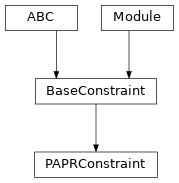
Inheritance diagram for PAPRConstraint
- class kaira.constraints.PAPRConstraint(max_papr: float = 3.0, *args, **kwargs)[source]
Bases:
BaseConstraintReduces peak-to-average power ratio using soft clipping to minimize signal distortion.
Limits the peak-to-average power ratio of the signal, which is critical in OFDM and multicarrier systems to reduce nonlinear distortions and improve power amplifier efficiency [Han and Lee, 2005] [Jiang and Wu, 2008].
This constraint applies soft clipping to signal peaks that would cause the PAPR to exceed the specified threshold, while preserving the signal shape as much as possible. The PAPR reduction techniques are extensively studied in wireless communications [Tellambura, 2001].
Methods
Initialize the PAPR constraint.
Apply PAPR constraint to the input tensor.
Helper method to get all dimensions except batch for calculating norms/means.
- __init__(max_papr: float = 3.0, *args, **kwargs) None[source]
Initialize the PAPR constraint.
- Parameters:
max_papr (float, optional) – Maximum allowed peak-to-average power ratio in linear units (not dB). For reference, a max_papr of 4.0 corresponds to approximately 6 dB. Defaults to 3.0.
*args – Variable length argument list.
**kwargs – Arbitrary keyword arguments.
- forward(x: Tensor, *args, **kwargs) Tensor[source]
Apply PAPR constraint to the input tensor.
Finds signal peaks that cause excessive PAPR and scales them down to meet the constraint while preserving the overall signal shape.
- Parameters:
x (torch.Tensor) – The input tensor of any shape
*args – Variable length argument list.
**kwargs – Arbitrary keyword arguments.
- Returns:
Signal with constrained PAPR with the same shape as input
- Return type:
Note
This implementation uses a multi-iteration approach to ensure the PAPR constraint is strictly enforced even for challenging signals.
- static get_dimensions(x: Tensor, exclude_batch: bool = True) Tuple[int, ...]
Helper method to get all dimensions except batch for calculating norms/means.
Utility function to generate dimension indices for reduction operations like mean or norm. Typically used to calculate signal properties across all dimensions except the batch dimension.
- Parameters:
x (torch.Tensor) – Input tensor
exclude_batch (bool, optional) – Whether to exclude the batch dimension (first dimension). Defaults to True.
- Returns:
Dimensions to use for reduction operations (e.g., mean, norm)
- Return type:
Tuple[int, …]
Example
>>> x = torch.randn(32, 4, 128)  # [batch, antennas, time]
>>> dims = BaseConstraint.get_dimensions(x)
>>> # dims will be (1, 2) for summing across antennas and time