kaira.models.image.Yilmaz2024DeepJSCCWZConditionalEncoder
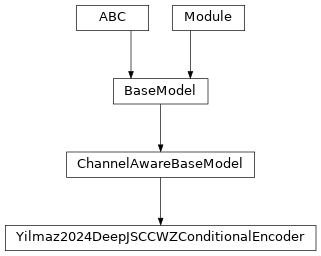
Inheritance diagram for Yilmaz2024DeepJSCCWZConditionalEncoder
- class kaira.models.image.Yilmaz2024DeepJSCCWZConditionalEncoder(N: int, M: int, *args: Any, **kwargs: Any)[source]
Bases:
ChannelAwareBaseModelDeepJSCC-WZ Conditional Encoder Module [Yilmaz et al., 2024].
This variant of the DeepJSCC-WZ encoder actively incorporates side information during the encoding process. This model is designed for scenarios where side information is available at both encoder and decoder, serving as an upper bound for performance comparison.
The conditional encoder features three processing paths: - g_a: Main encoding path that fuses the input with side information features - g_a2: Processing path for side information for the decoder - g_a3: Auxiliary path for feature extraction from side information for the encoder
By leveraging correlations between the main signal and side information at encoding time, this model achieves more efficient compression and better reconstruction quality compared to the standard DeepJSCC-WZ model, at the cost of requiring side information during encoding.
Architecture highlights: - Early fusion of input and side information (6-channel input) - Multi-scale feature fusion with side information - 4 stages of downsampling (16× spatial reduction) - Channel-adaptive processing with AFModule
Methods
Initialize the conditional DeepJSCC-WZ encoder.
Create appropriate CSI tensors for multiple submodules.
Extract common features from CSI tensor for analysis.
Extract CSI from channel output if available.
Format CSI tensor for passing to channels that expect specific formats.
Encode the input image with conditional side information.
Helper method to consistently pass CSI to submodules.
Normalize CSI values to a specified range.
Transform CSI tensor to match target shape requirements.
Validate and ensure CSI tensor is in the correct format.
- __init__(N: int, M: int, *args: Any, **kwargs: Any) None[source]
Initialize the conditional DeepJSCC-WZ encoder.
- Parameters:
N (int) – Number of intermediate channels in the residual blocks. Controls the network capacity and feature dimension.
M (int) – Number of output channels in the final latent representation. Determines the compression rate and bandwidth usage.
*args – Variable positional arguments passed to the base class.
**kwargs – Variable keyword arguments passed to the base class.
- forward(x: Tensor, x_side: Tensor, csi: Tensor, *args: Any, **kwargs: Any) Tensor[source]
Encode the input image with conditional side information.
This method processes both the main input image and side information in parallel, fusing features from the side information stream into the main encoding path at multiple scales. The side information is available at the encoder, allowing for more efficient compression compared to the standard DeepJSCC-WZ model.
- Parameters:
x (torch.Tensor) – Input image tensor of shape [B, 3, H, W].
x_side (torch.Tensor) – Side information tensor of shape [B, 3, H, W] used during encoding.
csi (torch.Tensor) – Channel state information tensor of shape [B, 1, 1, 1].
*args – Additional positional arguments (passed to internal layers).
**kwargs – Additional keyword arguments (passed to internal layers).
- Returns:
- Encoded representation ready for transmission.
Shape: [B, M, H/16, W/16], where M is the number of channels specified during initialization.
- Return type:
- create_csi_for_submodules(csi: Tensor, num_modules: int) List[Tensor]
Create appropriate CSI tensors for multiple submodules.
- Parameters:
csi (torch.Tensor) – Original CSI tensor
num_modules (int) – Number of submodules that need CSI
- Returns:
List of CSI tensors for each submodule
- Return type:
List[torch.Tensor]
- extract_csi_features(csi: Tensor) Dict[str, Tensor]
Extract common features from CSI tensor for analysis.
- Parameters:
csi (torch.Tensor) – The CSI tensor to analyze
- Returns:
Dictionary containing extracted features
- Return type:
Dict[str, torch.Tensor]
- static extract_csi_from_channel_output(channel_output: Any) Tensor | None
Extract CSI from channel output if available.
Some channels return both the transmitted signal and CSI information. This static method provides a standardized way to extract CSI from various channel output formats.
- Parameters:
channel_output – Output from a channel, which may contain CSI
- Returns:
Extracted CSI tensor if available, None otherwise
- Return type:
Optional[torch.Tensor]
- static format_csi_for_channel(csi: Tensor, channel_format: str = 'tensor') Any
Format CSI tensor for passing to channels that expect specific formats.
- Parameters:
csi (torch.Tensor) – CSI tensor to format
channel_format (str) – Expected format (“tensor”, “dict”, “kwargs”)
- Returns:
Formatted CSI in the requested format
- Return type:
Any
- forward_csi_to_submodules(csi: Tensor, modules: List[BaseModel], *args, **kwargs) List[Any]
Helper method to consistently pass CSI to submodules.
This method facilitates passing CSI to multiple submodules that require channel state information, ensuring consistent handling across the model.
- Parameters:
csi (torch.Tensor) – Channel state information tensor
modules (List[BaseModel]) – List of modules to apply
*args – Positional arguments to pass to modules
**kwargs – Keyword arguments to pass to modules
- Returns:
List of outputs from each module
- Return type:
List[Any]
- normalize_csi(csi: Tensor, method: str = 'minmax', target_range: tuple = (0.0, 1.0)) Tensor
Normalize CSI values to a specified range.
- Parameters:
csi (torch.Tensor) – The CSI tensor to normalize
method (str) – Normalization method. Options: “minmax”, “zscore”, “none”
target_range (tuple) – Target range for minmax normalization (min, max)
- Returns:
Normalized CSI tensor
- Return type:
- Raises:
ValueError – If normalization method is not supported
- transform_csi(csi: Tensor, target_shape: Size) Tensor
Transform CSI tensor to match target shape requirements.
- Parameters:
csi (torch.Tensor) – The CSI tensor to transform
target_shape (torch.Size) – Target shape for the CSI tensor
- Returns:
Transformed CSI tensor
- Return type:
- validate_csi(csi: Tensor, expected_shape: Size | None = None) Tensor
Validate and ensure CSI tensor is in the correct format.
- Parameters:
csi (torch.Tensor) – The CSI tensor to validate
expected_shape (Optional[torch.Size]) – Expected shape for the CSI tensor. If None, uses cached shape or infers from tensor.
- Returns:
Validated CSI tensor
- Return type:
- Raises:
ValueError – If CSI tensor is invalid or has incorrect shape
TypeError – If CSI is not a tensor