Note
Go to the end to download the full example code. or to run this example in your browser via Binder
Comprehensive Error Correction Codes Benchmark
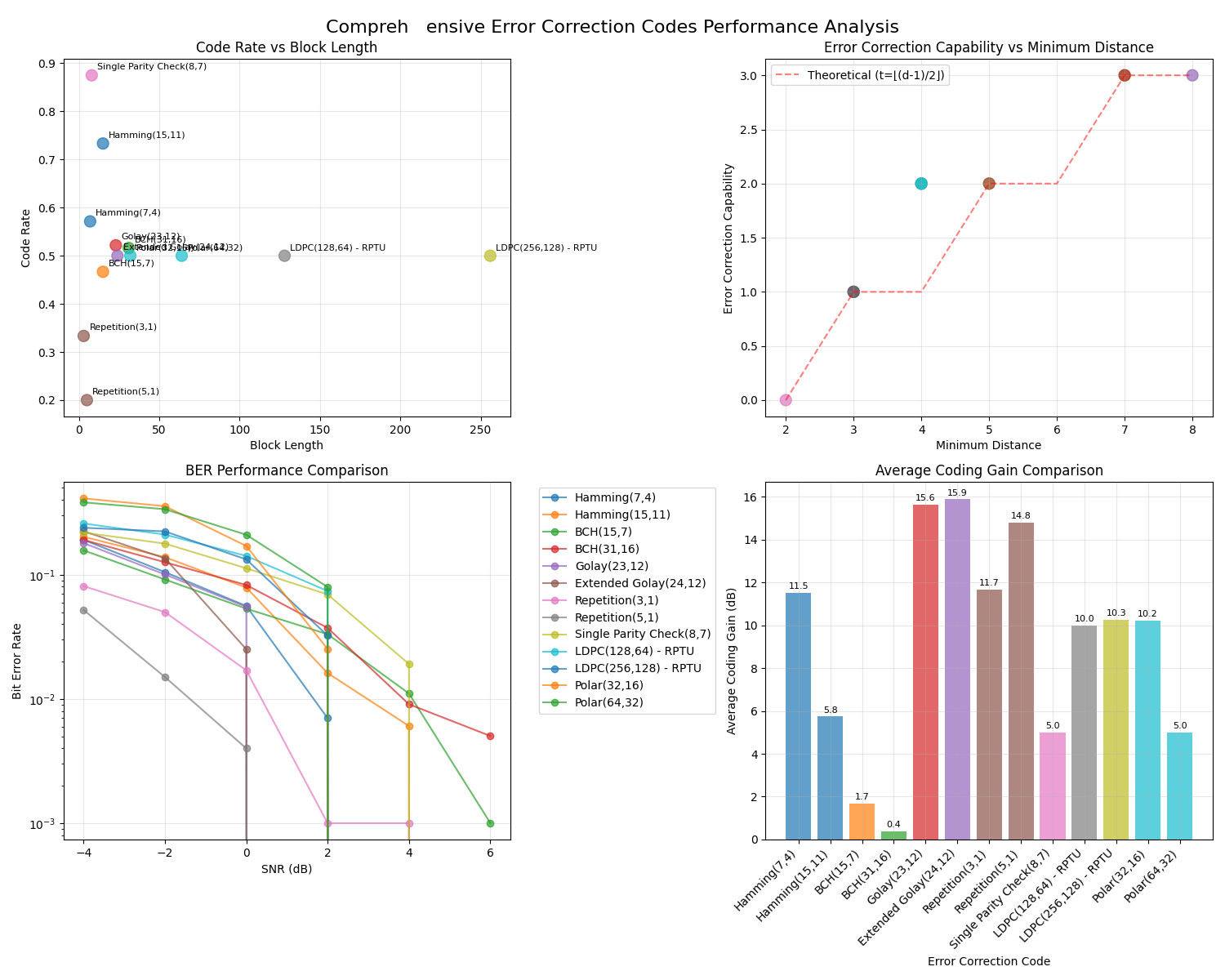
This example demonstrates a comprehensive benchmark for Forward Error Correction (FEC) codes using the Kaira benchmarking system. It evaluates multiple ECC algorithms across different parameters and provides detailed performance comparison.
The comprehensive ECC benchmark includes:
Multiple error correction codes (Hamming, BCH, Golay, Repetition, Single Parity Check)
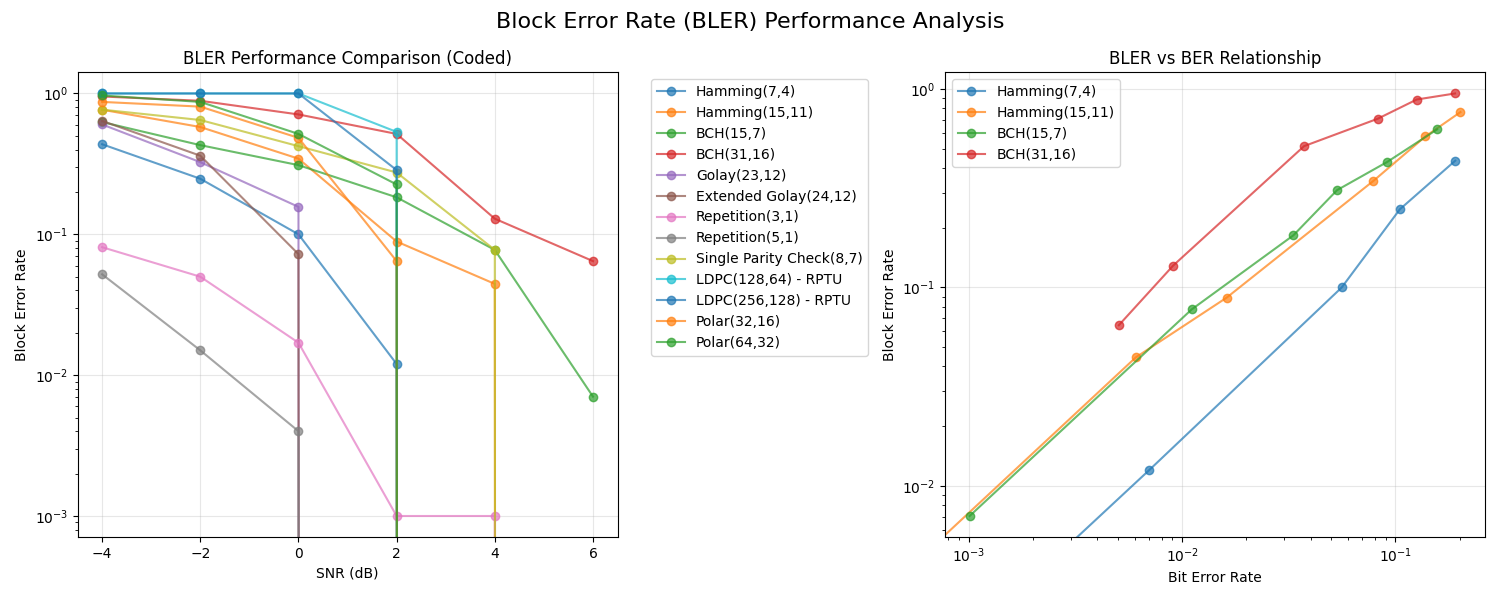
Block Error Rate (BLER) and Bit Error Rate (BER) evaluation
Coding gain analysis
Error correction capability evaluation
Comparison across different code rates and block lengths
Note: Individual benchmarks use only repetition codes (the only code type currently supported by ChannelCodingBenchmark), while the comprehensive benchmark tests all available ECC implementations directly using the FEC encoder/decoder classes.
Setting up the Environment
First, let’s import the necessary modules for comprehensive ECC benchmarking.
from pathlib import Path
from typing import Any, Dict

import matplotlib.pyplot as plt
import numpy as np
import torch

from kaira.benchmarks import (
    BenchmarkConfig,
    BenchmarkSuite,
    StandardRunner,
    create_benchmark,
    register_benchmark,
)
from kaira.benchmarks.base import CommunicationBenchmark
from kaira.benchmarks.metrics import StandardMetrics
from kaira.channels.analog import AWGNChannel
from kaira.models.fec.decoders import (
    BeliefPropagationDecoder,
    BruteForceMLDecoder,
    SuccessiveCancellationDecoder,
    SyndromeLookupDecoder,
)
from kaira.models.fec.encoders import (
    BCHCodeEncoder,
    GolayCodeEncoder,
    HammingCodeEncoder,
    LDPCCodeEncoder,
    PolarCodeEncoder,
    RepetitionCodeEncoder,
    SingleParityCheckCodeEncoder,
)
from kaira.modulations.psk import BPSKDemodulator, BPSKModulator
from kaira.utils import snr_to_noise_power

# Set random seed for reproducibility
np.random.seed(42)
torch.manual_seed(42)
<torch._C.Generator object at 0x7f19765aa410>
Creating the Comprehensive ECC Benchmark
Let’s create a comprehensive benchmark that evaluates multiple ECC algorithms.
@register_benchmark("comprehensive_ecc")
class ComprehensiveECCBenchmark(CommunicationBenchmark):
    """Comprehensive benchmark for error correction codes."""

    def __init__(self, **kwargs):
        """Initialize comprehensive ECC benchmark."""
        super().__init__(name="Comprehensive ECC Benchmark", description="Comprehensive evaluation of error correction codes")

    def setup(self, **kwargs):
        """Setup benchmark parameters."""
        super().setup(**kwargs)
        self.num_bits = kwargs.get("num_bits", 1000)
        self.num_trials = kwargs.get("num_trials", 1000)
        self.max_errors = kwargs.get("max_errors", 10)
        self.snr_range = kwargs.get("snr_range", list(range(-4, 8, 2)))

        # Define ECC configurations to test
        self.ecc_configs = [
            {"name": "Hamming(7,4)", "encoder": HammingCodeEncoder, "decoder": SyndromeLookupDecoder, "params": {"mu": 3}, "block_length": 7, "info_length": 4, "min_distance": 3, "error_correction_capability": 1},
            {"name": "Hamming(15,11)", "encoder": HammingCodeEncoder, "decoder": SyndromeLookupDecoder, "params": {"mu": 4}, "block_length": 15, "info_length": 11, "min_distance": 3, "error_correction_capability": 1},
            {"name": "BCH(15,7)", "encoder": BCHCodeEncoder, "decoder": SyndromeLookupDecoder, "params": {"mu": 4, "delta": 5}, "block_length": 15, "info_length": 7, "min_distance": 5, "error_correction_capability": 2},
            {"name": "BCH(31,16)", "encoder": BCHCodeEncoder, "decoder": BruteForceMLDecoder, "params": {"mu": 5, "delta": 7}, "block_length": 31, "info_length": 16, "min_distance": 7, "error_correction_capability": 3},
            {"name": "Golay(23,12)", "encoder": GolayCodeEncoder, "decoder": BruteForceMLDecoder, "params": {"extended": False}, "block_length": 23, "info_length": 12, "min_distance": 7, "error_correction_capability": 3},
            {"name": "Extended Golay(24,12)", "encoder": GolayCodeEncoder, "decoder": BruteForceMLDecoder, "params": {"extended": True}, "block_length": 24, "info_length": 12, "min_distance": 8, "error_correction_capability": 3},
            {"name": "Repetition(3,1)", "encoder": RepetitionCodeEncoder, "decoder": BruteForceMLDecoder, "params": {"repetition_factor": 3}, "block_length": 3, "info_length": 1, "min_distance": 3, "error_correction_capability": 1},
            {"name": "Repetition(5,1)", "encoder": RepetitionCodeEncoder, "decoder": BruteForceMLDecoder, "params": {"repetition_factor": 5}, "block_length": 5, "info_length": 1, "min_distance": 5, "error_correction_capability": 2},
            {"name": "Single Parity Check(8,7)", "encoder": SingleParityCheckCodeEncoder, "decoder": BruteForceMLDecoder, "params": {"dimension": 7}, "block_length": 8, "info_length": 7, "min_distance": 2, "error_correction_capability": 0},  # Detection only
            {
                "name": "LDPC(128,64) - RPTU",
                "encoder": LDPCCodeEncoder,
                "decoder": BeliefPropagationDecoder,
                "params": {"rptu_database": True, "code_length": 128, "code_dimension": 64},
                "block_length": 128,
                "info_length": 64,
                "min_distance": 4,  # Approximate for LDPC
                "error_correction_capability": 2,  # Approximate
                "use_soft_decoding": True,
            },
            {
                "name": "LDPC(256,128) - RPTU",
                "encoder": LDPCCodeEncoder,
                "decoder": BeliefPropagationDecoder,
                "params": {"rptu_database": True, "code_length": 256, "code_dimension": 128},
                "block_length": 256,
                "info_length": 128,
                "min_distance": 4,  # Approximate for LDPC
                "error_correction_capability": 2,  # Approximate
                "use_soft_decoding": True,
            },
            {
                "name": "Polar(32,16)",
                "encoder": PolarCodeEncoder,
                "decoder": SuccessiveCancellationDecoder,
                "params": {"code_dimension": 16, "code_length": 32},
                "block_length": 32,
                "info_length": 16,
                "min_distance": 4,  # Approximate for Polar
                "error_correction_capability": 2,  # Approximate
                "use_soft_decoding": True,
            },
            {
                "name": "Polar(64,32)",
                "encoder": PolarCodeEncoder,
                "decoder": SuccessiveCancellationDecoder,
                "params": {"code_dimension": 32, "code_length": 64},
                "block_length": 64,
                "info_length": 32,
                "min_distance": 4,  # Approximate for Polar
                "error_correction_capability": 2,  # Approximate
                "use_soft_decoding": True,
            },
        ]

    def _generate_random_errors(self, codeword_length: int, num_errors: int) -> torch.Tensor:
        """Generate random error pattern."""
        error_pattern = torch.zeros(codeword_length, dtype=torch.float32, device=self.device)
        if num_errors > 0:
            error_positions = torch.randperm(codeword_length)[:num_errors]
            error_pattern[error_positions] = 1
        return error_pattern

    def _evaluate_error_correction_capability(self, config: dict) -> dict:
        """Evaluate error correction capability for a specific code."""
        encoder_class = config["encoder"]
        decoder_class = config["decoder"]

        # Initialize encoder and decoder
        try:
            encoder = encoder_class(**config["params"])
            # Handle different decoder types
            if decoder_class == BeliefPropagationDecoder:
                decoder = decoder_class(encoder=encoder, bp_iters=10)
            elif decoder_class == SuccessiveCancellationDecoder:
                decoder = decoder_class(encoder=encoder)
            else:
                # Traditional decoders that take encoder instance
                decoder = decoder_class(encoder=encoder)
        except Exception as e:
            print(f"Failed to initialize {config['name']}: {e}")
            return {"success": False, "error": str(e), "error_rates": [], "correction_rates": []}

        results: Dict[str, Any] = {"success": True, "error_rates": [], "correction_rates": [], "detection_rates": [], "block_error_rates": [], "bit_error_rates": []}

        # Test different numbers of errors
        for num_errors in range(self.max_errors + 1):
            correct_corrections = 0
            correct_detections = 0
            total_block_errors = 0
            total_bit_errors = 0
            total_bits = 0

            for _ in range(self.num_trials):
                # Generate random information bits - use float32 for consistency
                info_bits = torch.randint(0, 2, (config["info_length"],), dtype=torch.float32, device=self.device)

                # Encode - use forward method (__call__)
                try:
                    # Handle Polar code which expects 2D input
                    if config["encoder"] == PolarCodeEncoder:
                        input_bits = info_bits.unsqueeze(0)  # Add batch dimension
                        codeword = encoder(input_bits).squeeze(0)  # Remove batch dimension
                    else:
                        codeword = encoder(info_bits)
                except (RuntimeError, ValueError, TypeError, AttributeError, IndexError):
                    # Handle encoding failures (dimension mismatches, invalid parameters, etc.)
                    continue

                # Add errors
                error_pattern = self._generate_random_errors(len(codeword), num_errors)
                received = (codeword + error_pattern.float()) % 2

                # Decode - use forward method (__call__)
                try:
                    # Handle different decoder input requirements
                    if config.get("use_soft_decoding", False):
                        # Use proper BPSK modulation/demodulation pipeline for soft decoding
                        modulator = BPSKModulator(complex_output=False)
                        demodulator = BPSKDemodulator()

                        # Step 1: Modulate codeword to bipolar symbols (-1, +1)
                        bipolar_symbols = modulator(codeword.unsqueeze(0)).squeeze(0)  # Add/remove batch dim

                        # Step 2: Simulate channel with controlled errors
                        # Use SNR that allows num_errors to be correctable but challenging
                        target_snr_db = 2.0  # Moderate SNR for capability testing
                        noise_power = snr_to_noise_power(1.0, target_snr_db)
                        channel = AWGNChannel(avg_noise_power=noise_power)

                        # Apply channel noise
                        received_soft = channel(bipolar_symbols.unsqueeze(0)).squeeze(0)  # Add/remove batch dim

                        # Step 3: Demodulate to get proper LLRs
                        llr_received = demodulator(received_soft.unsqueeze(0), noise_var=noise_power).squeeze(0)

                        # Step 4: Decode using proper LLRs
                        input_received = llr_received.unsqueeze(0)  # Add batch dimension for decoder
                        decoded_info = decoder(input_received).squeeze(0)  # Remove batch dimension
                    else:
                        # Hard decoding for traditional codes
                        decoded_info = decoder(received)

                    # Check if decoding was successful
                    if torch.equal(info_bits, decoded_info):
                        correct_corrections += 1
                    else:
                        # Count bit errors
                        bit_errors = torch.sum(info_bits != decoded_info).item()
                        total_bit_errors += bit_errors
                        total_block_errors += 1

                except Exception:
                    # Decoding failed - count as detection if within capability
                    if num_errors <= config["error_correction_capability"]:
                        pass  # Should have been corrected
                    else:
                        correct_detections += 1

                total_bits += config["info_length"]

            # Calculate rates
            correction_rate = correct_corrections / self.num_trials if self.num_trials > 0 else 0
            detection_rate = correct_detections / self.num_trials if self.num_trials > 0 else 0
            block_error_rate = total_block_errors / self.num_trials if self.num_trials > 0 else 0
            bit_error_rate = total_bit_errors / total_bits if total_bits > 0 else 0

            results["correction_rates"].append(correction_rate)
            results["detection_rates"].append(detection_rate)
            results["block_error_rates"].append(block_error_rate)
            results["bit_error_rates"].append(bit_error_rate)

        return results

    def _evaluate_snr_performance(self, config: dict) -> dict:
        """Evaluate BER and BLER performance over SNR range."""
        encoder_class = config["encoder"]
        decoder_class = config["decoder"]

        try:
            encoder = encoder_class(**config["params"])
            # Handle different decoder types
            if decoder_class == BeliefPropagationDecoder:
                decoder = decoder_class(encoder=encoder, bp_iters=10)
            elif decoder_class == SuccessiveCancellationDecoder:
                decoder = decoder_class(encoder=encoder)
            else:
                decoder = decoder_class(encoder=encoder)
        except Exception as e:
            return {"success": False, "error": str(e), "ber_coded": [], "ber_uncoded": [], "bler_coded": [], "bler_uncoded": [], "coding_gain": []}

        ber_coded = []
        ber_uncoded = []
        bler_coded = []
        bler_uncoded = []
        coding_gain = []

        for snr_db in self.snr_range:
            # Generate information bits - use float32 for consistency
            num_info_bits = (self.num_bits // config["info_length"]) * config["info_length"]
            info_bits = torch.randint(0, 2, (num_info_bits,), dtype=torch.float32, device=self.device)

            # Reshape for block processing
            info_blocks = info_bits.reshape(-1, config["info_length"])

            # Encode all blocks
            coded_blocks = []
            for block in info_blocks:
                try:
                    # Handle Polar code which expects 2D input
                    if config["encoder"] == PolarCodeEncoder:
                        input_block = block.unsqueeze(0)  # Add batch dimension
                        coded_block = encoder(input_block).squeeze(0)  # Remove batch dimension
                        coded_blocks.append(coded_block)
                    else:
                        coded_blocks.append(encoder(block))
                except (RuntimeError, ValueError, TypeError, AttributeError, IndexError):
                    # Skip failed blocks (dimension mismatches, invalid parameters, etc.)
                    continue

            if not coded_blocks:
                ber_coded.append(1.0)
                ber_uncoded.append(1.0)
                bler_coded.append(1.0)
                bler_uncoded.append(1.0)
                coding_gain.append(0.0)
                continue

            coded_bits = torch.cat(coded_blocks)

            # BPSK modulation
            coded_symbols = 2 * coded_bits.float() - 1
            # For uncoded, use the same number of info bits as we have coded blocks
            num_uncoded_bits = len(info_blocks) * config["info_length"]
            uncoded_bits = info_bits[:num_uncoded_bits]
            uncoded_symbols = 2 * uncoded_bits.float() - 1

            # Add AWGN - SNR is per information bit (Eb/N0)
            # For fair comparison, both coded and uncoded should use same Eb/N0
            snr_linear = 10 ** (snr_db / 10)

            # Both systems use same SNR (same Eb/N0)
            coded_snr_linear = snr_linear
            uncoded_snr_linear = snr_linear

            # Noise calculation
            coded_noise_std = torch.sqrt(torch.tensor(1 / (2 * coded_snr_linear), device=self.device))
            uncoded_noise_std = torch.sqrt(torch.tensor(1 / (2 * uncoded_snr_linear), device=self.device))

            coded_received = coded_symbols + coded_noise_std * torch.randn_like(coded_symbols)
            uncoded_received = uncoded_symbols + uncoded_noise_std * torch.randn_like(uncoded_symbols)

            # Handle modern codes (LDPC, Polar) that need soft decoding
            if config["decoder"] in [BeliefPropagationDecoder, SuccessiveCancellationDecoder]:
                # Use proper BPSK modulation/demodulation pipeline for soft decoding
                modulator = BPSKModulator(complex_output=False)
                demodulator = BPSKDemodulator()

                coded_received_blocks = coded_bits.reshape(-1, config["block_length"])
                decoded_blocks = []

                for block in coded_received_blocks:
                    try:
                        # Step 1: Modulate codeword to bipolar symbols
                        bipolar_symbols = modulator(block.unsqueeze(0)).squeeze(0)

                        # Step 2: Add AWGN noise
                        noise_power = snr_to_noise_power(1.0, snr_db)
                        channel = AWGNChannel(avg_noise_power=noise_power)
                        received_soft = channel(bipolar_symbols.unsqueeze(0)).squeeze(0)

                        # Step 3: Demodulate to proper LLRs
                        llr_block = demodulator(received_soft.unsqueeze(0), noise_var=noise_power).squeeze(0)

                        # Step 4: Decode using proper LLRs
                        input_block = llr_block.unsqueeze(0)  # Add batch dimension
                        decoded_block = decoder(input_block).squeeze(0)  # Remove batch dimension
                        decoded_blocks.append(decoded_block)
                    except Exception:
                        # For failed decoding, generate random bits (worst case)
                        decoded_blocks.append(torch.randint(0, 2, (config["info_length"],), dtype=torch.float32, device=self.device))
            else:
                # Hard decision for traditional codes
                coded_hard = (coded_received > 0).float()
                uncoded_hard = (uncoded_received > 0).float()

                # Decode coded bits
                coded_hard_blocks = coded_hard.reshape(-1, config["block_length"])
                decoded_blocks = []

                for block in coded_hard_blocks:
                    try:
                        decoded_blocks.append(decoder(block))
                    except Exception:
                        # For failed decoding, generate random bits (worst case)
                        decoded_blocks.append(torch.randint(0, 2, (config["info_length"],), dtype=torch.float32, device=self.device))

            # Calculate metrics
            if decoded_blocks:
                decoded_bits = torch.cat(decoded_blocks)

                # Calculate coded BER and BLER
                original_info_bits = info_bits[: len(decoded_blocks) * config["info_length"]]
                ber_c = StandardMetrics.bit_error_rate(original_info_bits, decoded_bits)
                ber_coded.append(float(ber_c))

                # Calculate BLER (Block Error Rate)
                block_errors = 0
                for i, block in enumerate(decoded_blocks):
                    start_idx = i * config["info_length"]
                    end_idx = start_idx + config["info_length"]
                    original_block = original_info_bits[start_idx:end_idx]
                    if not torch.equal(original_block, block):
                        block_errors += 1
                bler_c = block_errors / len(decoded_blocks) if len(decoded_blocks) > 0 else 1.0
                bler_coded.append(bler_c)
            else:
                ber_coded.append(1.0)
                bler_coded.append(1.0)

            # Uncoded BER and BLER - Hard decision for uncoded case
            uncoded_hard = (uncoded_received > 0).float()
            ber_u = StandardMetrics.bit_error_rate(uncoded_bits, uncoded_hard)
            ber_uncoded.append(float(ber_u))

            # Uncoded BLER - treat each info_length block as a block
            uncoded_blocks = uncoded_bits.reshape(-1, config["info_length"])
            uncoded_hard_blocks = uncoded_hard.reshape(-1, config["info_length"])
            uncoded_block_errors = 0
            for orig_block, hard_block in zip(uncoded_blocks, uncoded_hard_blocks):
                if not torch.equal(orig_block, hard_block):
                    uncoded_block_errors += 1
            bler_u = uncoded_block_errors / len(uncoded_blocks) if len(uncoded_blocks) > 0 else 1.0
            bler_uncoded.append(bler_u)

            # Calculate coding gain
            if ber_u > 0 and ber_c > 0 and ber_c < ber_u:
                gain = 10 * torch.log10(torch.tensor(ber_u / ber_c)).item()
                coding_gain.append(gain)
            elif ber_u > 0 and ber_c == 0:
                # Perfect coding - use a high but finite gain
                coding_gain.append(30.0)  # High coding gain for perfect correction
            else:
                coding_gain.append(0.0)

        return {"success": True, "ber_coded": ber_coded, "ber_uncoded": ber_uncoded, "bler_coded": bler_coded, "bler_uncoded": bler_uncoded, "coding_gain": coding_gain}

    def run(self, **kwargs) -> dict:
        """Run comprehensive ECC benchmark."""
        results: Dict[str, Any] = {"success": True, "configurations": [], "error_correction_results": {}, "snr_performance_results": {}, "summary": {}}

        print(f"Running comprehensive ECC benchmark with {len(self.ecc_configs)} configurations...")

        for i, config in enumerate(self.ecc_configs):
            print(f"Evaluating {config['name']} ({i+1}/{len(self.ecc_configs)})...")

            # Store configuration info
            config_info = {"name": config["name"], "block_length": config["block_length"], "info_length": config["info_length"], "code_rate": config["info_length"] / config["block_length"], "min_distance": config["min_distance"], "error_correction_capability": config["error_correction_capability"]}
            results["configurations"].append(config_info)

            # Evaluate error correction capability
            ec_results = self._evaluate_error_correction_capability(config)
            results["error_correction_results"][config["name"]] = ec_results

            # Evaluate SNR performance
            snr_results = self._evaluate_snr_performance(config)
            results["snr_performance_results"][config["name"]] = snr_results

        return results
Running Individual ECC Algorithms
Let’s start by running individual ECC algorithms to understand their performance.
def run_individual_ecc_benchmarks():
    """Run individual ECC benchmarks."""
    print("Running Individual ECC Benchmarks...")

    # Configuration for individual tests - only using codes supported by ChannelCodingBenchmark
    configs = [("Repetition Code (Rate 1/3)", "repetition", 1 / 3), ("Repetition Code (Rate 1/5)", "repetition", 1 / 5), ("Repetition Code (Rate 1/7)", "repetition", 1 / 7)]

    results = {}

    for name, code_type, code_rate in configs:
        print(f"\nTesting {name}...")

        # Create channel coding benchmark for this specific code
        benchmark = create_benchmark("channel_coding", code_type=code_type, code_rate=code_rate)

        # Configure benchmark
        config = BenchmarkConfig(name=f"{name}_benchmark", snr_range=list(range(-2, 8, 2)), verbose=False)
        config.update(num_bits=5000)

        # Run benchmark
        runner = StandardRunner(verbose=False)
        result = runner.run_benchmark(benchmark, **config.to_dict())

        results[name] = result

        if result.metrics["success"]:
            print(f"  Average coding gain: {result.metrics.get('average_coding_gain', 0):.2f} dB")
        else:
            print("  Benchmark failed")

    return results
Running Comprehensive ECC Benchmark
Now let’s run our comprehensive benchmark that evaluates multiple aspects.
def run_comprehensive_ecc_benchmark():
    """Run the comprehensive ECC benchmark."""
    print("Running Comprehensive ECC Benchmark...")

    # Create comprehensive benchmark
    benchmark = create_benchmark("comprehensive_ecc")

    # Configure benchmark
    config = BenchmarkConfig(name="comprehensive_ecc_evaluation", snr_range=list(range(-4, 8, 2)), num_trials=50, verbose=True)
    config.update(num_bits=1000, max_errors=10)

    # Run benchmark
    runner = StandardRunner(verbose=True)
    result = runner.run_benchmark(benchmark, **config.to_dict())

    return result
Performance Comparison and Visualization
Let’s create comprehensive visualizations of ECC performance.
def visualize_ecc_performance(comprehensive_result):
    """Create comprehensive visualizations of ECC performance."""

    if not comprehensive_result.metrics["success"]:
        print("Comprehensive benchmark failed, cannot create visualizations")
        return

    configs = comprehensive_result.metrics["configurations"]
    snr_results = comprehensive_result.metrics["snr_performance_results"]

    # Create subplots for different aspects
    fig, axes = plt.subplots(2, 2, figsize=(15, 12))
    fig.suptitle("Compreh   ensive Error Correction Codes Performance Analysis", fontsize=16)

    # 1. Code Rate vs Block Length
    ax1 = axes[0, 0]
    block_lengths = [c["block_length"] for c in configs]
    code_rates = [c["code_rate"] for c in configs]
    names = [c["name"] for c in configs]

    ax1.scatter(block_lengths, code_rates, s=100, alpha=0.7, c=range(len(configs)), cmap="tab10")
    ax1.set_xlabel("Block Length")
    ax1.set_ylabel("Code Rate")
    ax1.set_title("Code Rate vs Block Length")
    ax1.grid(True, alpha=0.3)

    # Add labels
    for i, name in enumerate(names):
        ax1.annotate(name, (block_lengths[i], code_rates[i]), xytext=(5, 5), textcoords="offset points", fontsize=8)

    # 2. Error Correction Capability vs Minimum Distance
    ax2 = axes[0, 1]
    min_distances = [c["min_distance"] for c in configs]
    error_capabilities = [c["error_correction_capability"] for c in configs]

    ax2.scatter(min_distances, error_capabilities, s=100, alpha=0.7, c=range(len(configs)), cmap="tab10")
    ax2.set_xlabel("Minimum Distance")
    ax2.set_ylabel("Error Correction Capability")
    ax2.set_title("Error Correction Capability vs Minimum Distance")
    ax2.grid(True, alpha=0.3)

    # Add theoretical line (t = floor((d-1)/2))
    d_theory = np.arange(2, max(min_distances) + 1)
    t_theory = np.floor((d_theory - 1) / 2)
    ax2.plot(d_theory, t_theory, "r--", alpha=0.5, label="Theoretical (t=⌊(d-1)/2⌋)")
    ax2.legend()

    # 3. BER Performance Comparison
    ax3 = axes[1, 0]
    snr_range = list(range(-4, 8, 2))  # From config

    for name in names:
        if name in snr_results and snr_results[name]["success"]:
            ber_coded = snr_results[name]["ber_coded"]
            if len(ber_coded) == len(snr_range):
                ax3.semilogy(snr_range, ber_coded, "o-", label=name, alpha=0.7)

    ax3.set_xlabel("SNR (dB)")
    ax3.set_ylabel("Bit Error Rate")
    ax3.set_title("BER Performance Comparison")
    ax3.grid(True, alpha=0.3)
    ax3.legend(bbox_to_anchor=(1.05, 1), loc="upper left")

    # 4. Coding Gain Analysis
    ax4 = axes[1, 1]
    avg_gains = []

    for name in names:
        if name in snr_results and snr_results[name]["success"]:
            gains = snr_results[name]["coding_gain"]
            finite_gains = [g for g in gains if np.isfinite(g)]
            avg_gain = np.mean(finite_gains) if finite_gains else 0
            avg_gains.append(avg_gain)
        else:
            avg_gains.append(0)

    bars = ax4.bar(range(len(names)), avg_gains, alpha=0.7, color=plt.cm.tab10(np.linspace(0, 1, len(names))))
    ax4.set_xlabel("Error Correction Code")
    ax4.set_ylabel("Average Coding Gain (dB)")
    ax4.set_title("Average Coding Gain Comparison")
    ax4.set_xticks(range(len(names)))
    ax4.set_xticklabels(names, rotation=45, ha="right")
    ax4.grid(True, alpha=0.3)

    # Add value labels on bars
    for i, (bar, gain) in enumerate(zip(bars, avg_gains)):
        ax4.text(bar.get_x() + bar.get_width() / 2, bar.get_height() + 0.1, f"{gain:.1f}", ha="center", va="bottom", fontsize=8)

    plt.tight_layout()
    plt.show()

    # Create additional figure for BLER comparison
    fig2, (ax5, ax6) = plt.subplots(1, 2, figsize=(15, 6))
    fig2.suptitle("Block Error Rate (BLER) Performance Analysis", fontsize=16)

    # 5. BLER Performance Comparison
    for name in names:
        if name in snr_results and snr_results[name]["success"] and "bler_coded" in snr_results[name]:
            bler_coded = snr_results[name]["bler_coded"]
            if len(bler_coded) == len(snr_range):
                ax5.semilogy(snr_range, bler_coded, "o-", label=name, alpha=0.7)

    ax5.set_xlabel("SNR (dB)")
    ax5.set_ylabel("Block Error Rate")
    ax5.set_title("BLER Performance Comparison (Coded)")
    ax5.grid(True, alpha=0.3)
    ax5.legend(bbox_to_anchor=(1.05, 1), loc="upper left")

    # 6. BLER vs BER Comparison for selected codes
    selected_codes = names[:4]  # Show first 4 codes to avoid clutter
    for name in selected_codes:
        if name in snr_results and snr_results[name]["success"]:
            ber_coded = snr_results[name].get("ber_coded", [])
            bler_coded = snr_results[name].get("bler_coded", [])
            if len(ber_coded) == len(snr_range) and len(bler_coded) == len(snr_range):
                ax6.loglog(ber_coded, bler_coded, "o-", label=f"{name}", alpha=0.7)

    ax6.set_xlabel("Bit Error Rate")
    ax6.set_ylabel("Block Error Rate")
    ax6.set_title("BLER vs BER Relationship")
    ax6.grid(True, alpha=0.3)
    ax6.legend()

    plt.tight_layout()
    plt.show()

    # Print summary statistics
    print("\n" + "=" * 60)
    print("COMPREHENSIVE ECC BENCHMARK SUMMARY")
    print("=" * 60)

    for i, config in enumerate(configs):
        name = config["name"]
        print(f"\n{name}:")
        print(f"  Block Length: {config['block_length']}")
        print(f"  Information Length: {config['info_length']}")
        print(f"  Code Rate: {config['code_rate']:.3f}")
        print(f"  Minimum Distance: {config['min_distance']}")
        print(f"  Error Correction Capability: {config['error_correction_capability']}")

        if name in snr_results and snr_results[name]["success"]:
            avg_gain = avg_gains[i]
            print(f"  Average Coding Gain: {avg_gain:.2f} dB")

            # Best BER achieved
            ber_coded = snr_results[name]["ber_coded"]
            if ber_coded:
                best_ber = min([b for b in ber_coded if b > 0])
                print(f"  Best BER Achieved: {best_ber:.2e}")
        else:
            print("  SNR evaluation failed")
Creating ECC Benchmark Suite
Let’s create a benchmark suite for systematic evaluation.
def create_ecc_benchmark_suite():
    """Create a comprehensive ECC benchmark suite."""
    print("Creating ECC Benchmark Suite...")

    # Create benchmark suite
    suite = BenchmarkSuite(name="ECC Comprehensive Evaluation", description="Comprehensive evaluation of error correction codes")

    # Add individual benchmarks
    suite.add_benchmark(create_benchmark("comprehensive_ecc"))

    # Add channel coding benchmarks for different configurations
    ecc_configs = [
        ("repetition", 1 / 3, "Repetition Code (Rate 1/3)"),
        ("repetition", 1 / 5, "Repetition Code (Rate 1/5)"),
    ]

    for code_type, rate, description in ecc_configs:
        suite.add_benchmark(create_benchmark("channel_coding", code_type=code_type, code_rate=rate))

    # Configure suite
    config = BenchmarkConfig(name="ecc_suite_evaluation", snr_range=list(range(-4, 10, 2)), num_trials=1000, verbose=True)
    config.update(num_bits=1000)

    return suite, config
Running the Complete ECC Evaluation
Let’s run the complete evaluation pipeline.
def run_complete_ecc_evaluation():
    """Run the complete ECC evaluation pipeline."""
    print("Starting Complete ECC Evaluation Pipeline...")

    # Run individual benchmarks
    print("\n" + "=" * 50)
    print("PHASE 1: Individual ECC Benchmarks")
    print("=" * 50)
    individual_results = run_individual_ecc_benchmarks()

    # Run comprehensive benchmark
    print("\n" + "=" * 50)
    print("PHASE 2: Comprehensive ECC Benchmark")
    print("=" * 50)
    comprehensive_result = run_comprehensive_ecc_benchmark()

    # Create visualizations
    print("\n" + "=" * 50)
    print("PHASE 3: Performance Visualization")
    print("=" * 50)
    visualize_ecc_performance(comprehensive_result)

    # Run benchmark suite
    print("\n" + "=" * 50)
    print("PHASE 4: Benchmark Suite Evaluation")
    print("=" * 50)
    suite, config = create_ecc_benchmark_suite()

    runner = StandardRunner(verbose=True)
    suite_results = runner.run_suite(suite, **config.to_dict())

    print(f"\nSuite completed with {len(suite_results)} benchmark results")

    return {"individual_results": individual_results, "comprehensive_result": comprehensive_result, "suite_results": suite_results}
Main Execution
Run the complete ECC evaluation when this script is executed.
if __name__ == "__main__":
    # Set up matplotlib for better plots
    plt.style.use("default")
    plt.rcParams["figure.figsize"] = (12, 8)
    plt.rcParams["font.size"] = 10

    # Run complete evaluation
    all_results = run_complete_ecc_evaluation()

    print("\n" + "=" * 60)
    print("ECC COMPREHENSIVE BENCHMARK COMPLETED SUCCESSFULLY!")
    print("=" * 60)
    print("\nResults Summary:")
    print(f"- Individual benchmarks: {len(all_results['individual_results'])}")
    print(f"- Comprehensive evaluation: {'✓' if all_results['comprehensive_result'].metrics['success'] else '✗'}")
    print(f"- Suite benchmarks: {len(all_results['suite_results'])}")

    # Save results
    results_dir = Path("./ecc_benchmark_results")
    results_dir.mkdir(exist_ok=True)

    # Save comprehensive results
    all_results["comprehensive_result"].save(results_dir / "comprehensive_ecc_results.json")

    print(f"\nResults saved to: {results_dir}")
    print("\nFor more examples, see the Kaira documentation at: https://kaira.readthedocs.io/")
Starting Complete ECC Evaluation Pipeline...

==================================================
PHASE 1: Individual ECC Benchmarks
==================================================
Running Individual ECC Benchmarks...

Testing Repetition Code (Rate 1/3)...
  Average coding gain: 5.76 dB

Testing Repetition Code (Rate 1/5)...
  Average coding gain: 8.89 dB

Testing Repetition Code (Rate 1/7)...
  Average coding gain: 10.60 dB

==================================================
PHASE 2: Comprehensive ECC Benchmark
==================================================
Running Comprehensive ECC Benchmark...
Running benchmark: Comprehensive ECC Benchmark
Running comprehensive ECC benchmark with 13 configurations...
Evaluating Hamming(7,4) (1/13)...
Evaluating Hamming(15,11) (2/13)...
Evaluating BCH(15,7) (3/13)...
Evaluating BCH(31,16) (4/13)...
Evaluating Golay(23,12) (5/13)...
Evaluating Extended Golay(24,12) (6/13)...
Evaluating Repetition(3,1) (7/13)...
Evaluating Repetition(5,1) (8/13)...
Evaluating Single Parity Check(8,7) (9/13)...
Evaluating LDPC(128,64) - RPTU (10/13)...
Loading LDPC code from RPTU database...
Michael Helmling, Stefan Scholl, Florian Gensheimer, Tobias Dietz, Kira Kraft, Oliver Griebel, Stefan Ruzika, and Norbert Wehn. Database of Channel Codes and ML Simulation Results. rptu.de/channel-codes, 2025.
------------------------------------
Using default rptu_standart='ccsds' for (code_length=128, code_dimension=64).
Loading LDPC code from RPTU database...
Michael Helmling, Stefan Scholl, Florian Gensheimer, Tobias Dietz, Kira Kraft, Oliver Griebel, Stefan Ruzika, and Norbert Wehn. Database of Channel Codes and ML Simulation Results. rptu.de/channel-codes, 2025.
------------------------------------
Using default rptu_standart='ccsds' for (code_length=128, code_dimension=64).
Evaluating LDPC(256,128) - RPTU (11/13)...
Loading LDPC code from RPTU database...
Michael Helmling, Stefan Scholl, Florian Gensheimer, Tobias Dietz, Kira Kraft, Oliver Griebel, Stefan Ruzika, and Norbert Wehn. Database of Channel Codes and ML Simulation Results. rptu.de/channel-codes, 2025.
------------------------------------
Using default rptu_standart='ccsds' for (code_length=256, code_dimension=128).
Loading LDPC code from RPTU database...
Michael Helmling, Stefan Scholl, Florian Gensheimer, Tobias Dietz, Kira Kraft, Oliver Griebel, Stefan Ruzika, and Norbert Wehn. Database of Channel Codes and ML Simulation Results. rptu.de/channel-codes, 2025.
------------------------------------
Using default rptu_standart='ccsds' for (code_length=256, code_dimension=128).
Evaluating Polar(32,16) (12/13)...
Loading rank polar indices as defined in 5G standard...
Loading rank polar indices as defined in 5G standard...
Evaluating Polar(64,32) (13/13)...
Loading rank polar indices as defined in 5G standard...
Loading rank polar indices as defined in 5G standard...
  ✓ Completed in 49.15s

==================================================
PHASE 3: Performance Visualization
==================================================

============================================================
COMPREHENSIVE ECC BENCHMARK SUMMARY
============================================================

Hamming(7,4):
  Block Length: 7
  Information Length: 4
  Code Rate: 0.571
  Minimum Distance: 3
  Error Correction Capability: 1
  Average Coding Gain: 11.53 dB
  Best BER Achieved: 7.00e-03

Hamming(15,11):
  Block Length: 15
  Information Length: 11
  Code Rate: 0.733
  Minimum Distance: 3
  Error Correction Capability: 1
  Average Coding Gain: 5.75 dB
  Best BER Achieved: 6.06e-03

BCH(15,7):
  Block Length: 15
  Information Length: 7
  Code Rate: 0.467
  Minimum Distance: 5
  Error Correction Capability: 2
  Average Coding Gain: 1.69 dB
  Best BER Achieved: 1.01e-03

BCH(31,16):
  Block Length: 31
  Information Length: 16
  Code Rate: 0.516
  Minimum Distance: 7
  Error Correction Capability: 3
  Average Coding Gain: 0.38 dB
  Best BER Achieved: 5.04e-03

Golay(23,12):
  Block Length: 23
  Information Length: 12
  Code Rate: 0.522
  Minimum Distance: 7
  Error Correction Capability: 3
  Average Coding Gain: 15.64 dB
  Best BER Achieved: 5.52e-02

Extended Golay(24,12):
  Block Length: 24
  Information Length: 12
  Code Rate: 0.500
  Minimum Distance: 8
  Error Correction Capability: 3
  Average Coding Gain: 15.89 dB
  Best BER Achieved: 2.51e-02

Repetition(3,1):
  Block Length: 3
  Information Length: 1
  Code Rate: 0.333
  Minimum Distance: 3
  Error Correction Capability: 1
  Average Coding Gain: 11.68 dB
  Best BER Achieved: 1.00e-03

Repetition(5,1):
  Block Length: 5
  Information Length: 1
  Code Rate: 0.200
  Minimum Distance: 5
  Error Correction Capability: 2
  Average Coding Gain: 14.80 dB
  Best BER Achieved: 4.00e-03

Single Parity Check(8,7):
  Block Length: 8
  Information Length: 7
  Code Rate: 0.875
  Minimum Distance: 2
  Error Correction Capability: 0
  Average Coding Gain: 5.00 dB
  Best BER Achieved: 1.91e-02

LDPC(128,64) - RPTU:
  Block Length: 128
  Information Length: 64
  Code Rate: 0.500
  Minimum Distance: 4
  Error Correction Capability: 2
  Average Coding Gain: 10.00 dB
  Best BER Achieved: 7.40e-02

LDPC(256,128) - RPTU:
  Block Length: 256
  Information Length: 128
  Code Rate: 0.500
  Minimum Distance: 4
  Error Correction Capability: 2
  Average Coding Gain: 10.27 dB
  Best BER Achieved: 3.24e-02

Polar(32,16):
  Block Length: 32
  Information Length: 16
  Code Rate: 0.500
  Minimum Distance: 4
  Error Correction Capability: 2
  Average Coding Gain: 10.22 dB
  Best BER Achieved: 2.52e-02

Polar(64,32):
  Block Length: 64
  Information Length: 32
  Code Rate: 0.500
  Minimum Distance: 4
  Error Correction Capability: 2
  Average Coding Gain: 5.00 dB
  Best BER Achieved: 7.96e-02

==================================================
PHASE 4: Benchmark Suite Evaluation
==================================================
Creating ECC Benchmark Suite...
Running benchmark suite: ECC Comprehensive Evaluation
  3 benchmarks to run
  [1/3] Comprehensive ECC Benchmark
Running benchmark: Comprehensive ECC Benchmark
Running comprehensive ECC benchmark with 13 configurations...
Evaluating Hamming(7,4) (1/13)...
Evaluating Hamming(15,11) (2/13)...
Evaluating BCH(15,7) (3/13)...
Evaluating BCH(31,16) (4/13)...
Evaluating Golay(23,12) (5/13)...
Evaluating Extended Golay(24,12) (6/13)...
Evaluating Repetition(3,1) (7/13)...
Evaluating Repetition(5,1) (8/13)...
Evaluating Single Parity Check(8,7) (9/13)...
Evaluating LDPC(128,64) - RPTU (10/13)...
Loading LDPC code from RPTU database...
Michael Helmling, Stefan Scholl, Florian Gensheimer, Tobias Dietz, Kira Kraft, Oliver Griebel, Stefan Ruzika, and Norbert Wehn. Database of Channel Codes and ML Simulation Results. rptu.de/channel-codes, 2025.
------------------------------------
Using default rptu_standart='ccsds' for (code_length=128, code_dimension=64).
Loading LDPC code from RPTU database...
Michael Helmling, Stefan Scholl, Florian Gensheimer, Tobias Dietz, Kira Kraft, Oliver Griebel, Stefan Ruzika, and Norbert Wehn. Database of Channel Codes and ML Simulation Results. rptu.de/channel-codes, 2025.
------------------------------------
Using default rptu_standart='ccsds' for (code_length=128, code_dimension=64).
Evaluating LDPC(256,128) - RPTU (11/13)...
Loading LDPC code from RPTU database...
Michael Helmling, Stefan Scholl, Florian Gensheimer, Tobias Dietz, Kira Kraft, Oliver Griebel, Stefan Ruzika, and Norbert Wehn. Database of Channel Codes and ML Simulation Results. rptu.de/channel-codes, 2025.
------------------------------------
Using default rptu_standart='ccsds' for (code_length=256, code_dimension=128).
Loading LDPC code from RPTU database...
Michael Helmling, Stefan Scholl, Florian Gensheimer, Tobias Dietz, Kira Kraft, Oliver Griebel, Stefan Ruzika, and Norbert Wehn. Database of Channel Codes and ML Simulation Results. rptu.de/channel-codes, 2025.
------------------------------------
Using default rptu_standart='ccsds' for (code_length=256, code_dimension=128).
Evaluating Polar(32,16) (12/13)...
Loading rank polar indices as defined in 5G standard...
Loading rank polar indices as defined in 5G standard...
Evaluating Polar(64,32) (13/13)...
Loading rank polar indices as defined in 5G standard...
Loading rank polar indices as defined in 5G standard...
  ✓ Completed in 394.01s
  [2/3] Channel Coding (repetition, R=0.3333333333333333)
Running benchmark: Channel Coding (repetition, R=0.3333333333333333)
  ✓ Completed in 0.02s
  [3/3] Channel Coding (repetition, R=0.2)
Running benchmark: Channel Coding (repetition, R=0.2)
  ✓ Completed in 0.02s

Suite completed with 3 benchmark results

============================================================
ECC COMPREHENSIVE BENCHMARK COMPLETED SUCCESSFULLY!
============================================================

Results Summary:
- Individual benchmarks: 3
- Comprehensive evaluation: ✓
- Suite benchmarks: 3

Results saved to: ecc_benchmark_results

For more examples, see the Kaira documentation at: https://kaira.readthedocs.io/
Total running time of the script: (7 minutes 24.409 seconds)
