Note
Go to the end to download the full example code. or to run this example in your browser via Binder
Higher-Order PSK Modulation
This example explores higher-order Phase-Shift Keying (PSK) modulation schemes in Kaira, focusing on 8-PSK and 16-PSK. Higher-order PSK schemes increase spectral efficiency by encoding more bits per symbol at the cost of reduced noise immunity.
import matplotlib.pyplot as plt
Imports and Setup
import numpy as np
import torch

from kaira.channels import AWGNChannel
from kaira.metrics.signal import BER
from kaira.modulations import PSKDemodulator, PSKModulator, QPSKDemodulator, QPSKModulator
from kaira.modulations.utils import calculate_spectral_efficiency, plot_constellation
from kaira.utils import snr_to_noise_power

# Set random seed for reproducibility
torch.manual_seed(42)
np.random.seed(42)
Create PSK Modulators with Different Orders
We’ll create modulators for QPSK, 8-PSK, and 16-PSK
qpsk_mod = QPSKModulator()  # Using specialized QPSK implementation
psk8_mod = PSKModulator(order=8)
psk16_mod = PSKModulator(order=16)

qpsk_demod = QPSKDemodulator()
psk8_demod = PSKDemodulator(order=8)
psk16_demod = PSKDemodulator(order=16)

# Display bits per symbol for each modulation
print(f"QPSK: {qpsk_mod.bits_per_symbol} bits/symbol")
print(f"8-PSK: {psk8_mod.bits_per_symbol} bits/symbol")
print(f"16-PSK: {psk16_mod.bits_per_symbol} bits/symbol")

# Calculate spectral efficiency
print(f"QPSK spectral efficiency: {calculate_spectral_efficiency('qpsk')} bits/s/Hz")
print(f"8-PSK spectral efficiency: {calculate_spectral_efficiency('8psk')} bits/s/Hz")
print(f"16-PSK spectral efficiency: {calculate_spectral_efficiency('16psk')} bits/s/Hz")
QPSK: 2 bits/symbol
8-PSK: 3 bits/symbol
16-PSK: 4 bits/symbol
QPSK spectral efficiency: 2.0 bits/s/Hz
8-PSK spectral efficiency: 3.0 bits/s/Hz
16-PSK spectral efficiency: 4.0 bits/s/Hz
Generate Test Data and Modulate
n_symbols = 1000

# Generate random bits for each modulation scheme
qpsk_bits = torch.randint(0, 2, (1, 2 * n_symbols))
psk8_bits = torch.randint(0, 2, (1, 3 * n_symbols))
psk16_bits = torch.randint(0, 2, (1, 4 * n_symbols))

# Modulate the bits
qpsk_symbols = qpsk_mod(qpsk_bits)
psk8_symbols = psk8_mod(psk8_bits)
psk16_symbols = psk16_mod(psk16_bits)
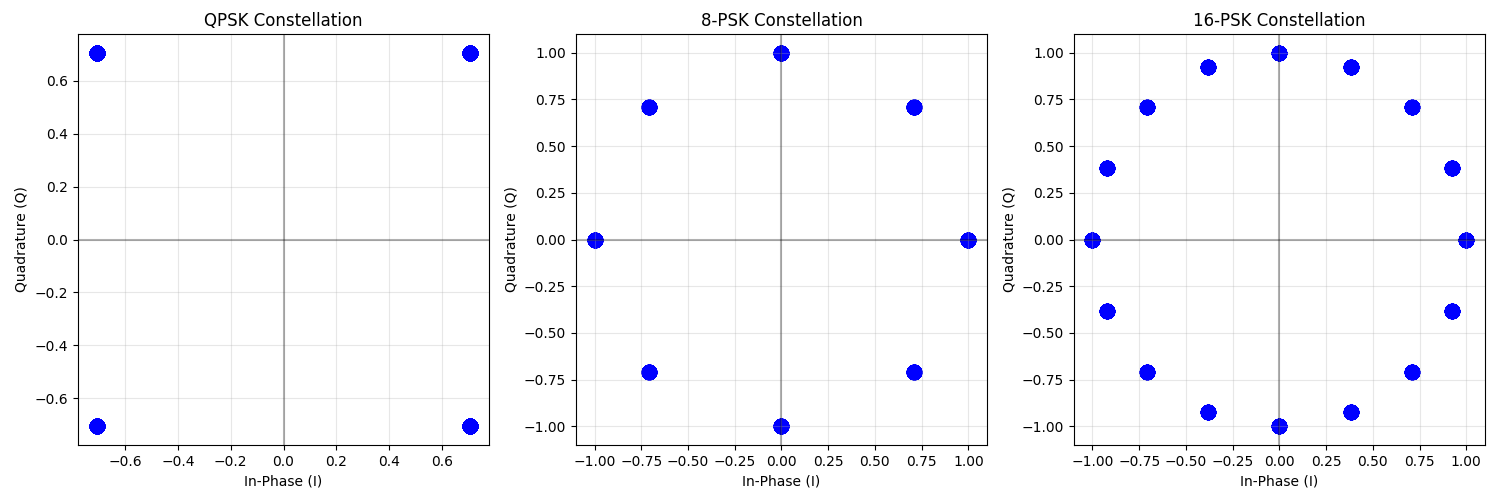
Visualize Constellation Diagrams
fig, axs = plt.subplots(1, 3, figsize=(15, 5))

# QPSK constellation
plot_constellation(qpsk_symbols.flatten(), title="QPSK Constellation", marker="o", ax=axs[0])
axs[0].grid(True)

# 8-PSK constellation
plot_constellation(psk8_symbols.flatten(), title="8-PSK Constellation", marker="o", ax=axs[1])
axs[1].grid(True)

# 16-PSK constellation
plot_constellation(psk16_symbols.flatten(), title="16-PSK Constellation", marker="o", ax=axs[2])
axs[2].grid(True)

plt.tight_layout()
plt.show()
Compare Symbol Distance
Higher-order PSK constellations have reduced distance between adjacent symbols
fig = plt.figure(figsize=(15, 5))

# Calculate min distances between adjacent symbols
# QPSK: symbols at 0, 90, 180, 270 degrees -> min dist = sqrt(2)
# 8-PSK: symbols at 0, 45, 90... degrees -> min dist = 2*sin(pi/8)
# 16-PSK: symbols at 0, 22.5, 45... degrees -> min dist = 2*sin(pi/16)

qpsk_min_dist = 2 * np.sin(np.pi / 4)
psk8_min_dist = 2 * np.sin(np.pi / 8)
psk16_min_dist = 2 * np.sin(np.pi / 16)

# Plot with normalized radius showing minimum distances
ax1 = fig.add_subplot(131)
circle = plt.Circle((0, 0), 1, fill=False, linestyle="--", color="gray")
ax1.add_patch(circle)
ax1.scatter([1, 0, -1, 0], [0, 1, 0, -1], color="blue")
ax1.plot([0, 1], [0, 0], color="red", linewidth=2)
ax1.set_xlim(-1.2, 1.2)
ax1.set_ylim(-1.2, 1.2)
ax1.grid(True)
ax1.set_title(f"QPSK\nMin Distance = {qpsk_min_dist:.3f}")
ax1.set_aspect("equal")

ax2 = fig.add_subplot(132)
circle = plt.Circle((0, 0), 1, fill=False, linestyle="--", color="gray")
ax2.add_patch(circle)
theta = np.linspace(0, 2 * np.pi, 8, endpoint=False)
ax2.scatter(np.cos(theta), np.sin(theta), color="blue")
ax2.plot([0, np.cos(0)], [0, np.sin(0)], color="red", linewidth=2)
ax2.plot([0, np.cos(np.pi / 4)], [0, np.sin(np.pi / 4)], color="red", linewidth=2)
ax2.set_xlim(-1.2, 1.2)
ax2.set_ylim(-1.2, 1.2)
ax2.grid(True)
ax2.set_title(f"8-PSK\nMin Distance = {psk8_min_dist:.3f}")
ax2.set_aspect("equal")

ax3 = fig.add_subplot(133)
circle = plt.Circle((0, 0), 1, fill=False, linestyle="--", color="gray")
ax3.add_patch(circle)
theta = np.linspace(0, 2 * np.pi, 16, endpoint=False)
ax3.scatter(np.cos(theta), np.sin(theta), color="blue")
ax3.plot([0, np.cos(0)], [0, np.sin(0)], color="red", linewidth=2)
ax3.plot([0, np.cos(np.pi / 8)], [0, np.sin(np.pi / 8)], color="red", linewidth=2)
ax3.set_xlim(-1.2, 1.2)
ax3.set_ylim(-1.2, 1.2)
ax3.grid(True)
ax3.set_title(f"16-PSK\nMin Distance = {psk16_min_dist:.3f}")
ax3.set_aspect("equal")

plt.tight_layout()
plt.show()

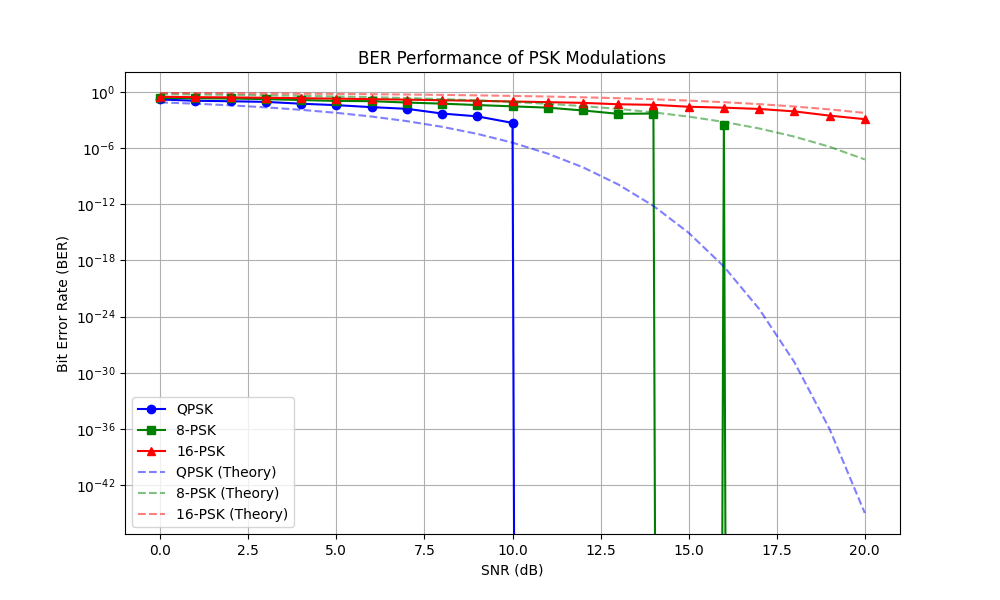
Performance in AWGN Channel
Compare BER for different PSK orders in AWGN
snr_db_range = np.arange(0, 21, 1)
ber_qpsk = []
ber_psk8 = []
ber_psk16 = []

# Initialize BER metric
ber_metric = BER()

for snr_db in snr_db_range:
    # Calculate noise power and create AWGN channel
    noise_power = snr_to_noise_power(1.0, snr_db)
    channel = AWGNChannel(avg_noise_power=noise_power)

    # QPSK transmission
    received_qpsk = channel(qpsk_symbols)
    demod_bits_qpsk = qpsk_demod(received_qpsk)
    ber_qpsk.append(ber_metric(demod_bits_qpsk, qpsk_bits).item())

    # 8-PSK transmission
    received_psk8 = channel(psk8_symbols)
    demod_bits_psk8 = psk8_demod(received_psk8)
    ber_psk8.append(ber_metric(demod_bits_psk8, psk8_bits).item())

    # 16-PSK transmission
    received_psk16 = channel(psk16_symbols)
    demod_bits_psk16 = psk16_demod(received_psk16)
    ber_psk16.append(ber_metric(demod_bits_psk16, psk16_bits).item())

# Plot BER vs SNR
plt.figure(figsize=(10, 6))
plt.semilogy(snr_db_range, ber_qpsk, "b-", marker="o", label="QPSK")
plt.semilogy(snr_db_range, ber_psk8, "g-", marker="s", label="8-PSK")
plt.semilogy(snr_db_range, ber_psk16, "r-", marker="^", label="16-PSK")

# Approximate theoretical bounds
snr_lin = 10 ** (snr_db_range / 10)
theoretical_ber_qpsk = torch.erfc(torch.sqrt(torch.tensor(snr_lin))) / 2
theoretical_ber_8psk = torch.erfc(torch.sqrt(torch.tensor(snr_lin) * np.sin(np.pi / 8) ** 2))
theoretical_ber_16psk = torch.erfc(torch.sqrt(torch.tensor(snr_lin) * np.sin(np.pi / 16) ** 2))

plt.semilogy(snr_db_range, theoretical_ber_qpsk, "b--", alpha=0.5, label="QPSK (Theory)")
plt.semilogy(snr_db_range, theoretical_ber_8psk, "g--", alpha=0.5, label="8-PSK (Theory)")
plt.semilogy(snr_db_range, theoretical_ber_16psk, "r--", alpha=0.5, label="16-PSK (Theory)")

plt.grid(True)
plt.xlabel("SNR (dB)")
plt.ylabel("Bit Error Rate (BER)")
plt.title("BER Performance of PSK Modulations")
plt.legend()
plt.show()
Effect of Noise on Constellations
Let’s visualize how noise affects the constellation diagrams at a fixed SNR
test_snr_db = 15  # 15 dB SNR
noise_power = snr_to_noise_power(1.0, test_snr_db)
channel = AWGNChannel(avg_noise_power=noise_power)

# Generate new test data
test_n_symbols = 500
test_qpsk_bits = torch.randint(0, 2, (1, 2 * test_n_symbols))
test_psk8_bits = torch.randint(0, 2, (1, 3 * test_n_symbols))
test_psk16_bits = torch.randint(0, 2, (1, 4 * test_n_symbols))

test_qpsk = qpsk_mod(test_qpsk_bits)
test_psk8 = psk8_mod(test_psk8_bits)
test_psk16 = psk16_mod(test_psk16_bits)

received_qpsk = channel(test_qpsk)
received_psk8 = channel(test_psk8)
received_psk16 = channel(test_psk16)

# Plot noisy constellations
fig, axs = plt.subplots(1, 3, figsize=(15, 5))

plot_constellation(received_qpsk.flatten(), title=f"QPSK at {test_snr_db} dB SNR", marker=".", ax=axs[0])
axs[0].grid(True)

plot_constellation(received_psk8.flatten(), title=f"8-PSK at {test_snr_db} dB SNR", marker=".", ax=axs[1])
axs[1].grid(True)

plot_constellation(received_psk16.flatten(), title=f"16-PSK at {test_snr_db} dB SNR", marker=".", ax=axs[2])
axs[2].grid(True)

plt.tight_layout()
plt.show()

Soft Demodulation
Demonstrate soft decision demodulation (LLR output)
test_snr_db = 10  # 10 dB SNR
noise_power = snr_to_noise_power(1.0, test_snr_db)

# Generate simple test sequence
test_qpsk_bits = torch.tensor([[0, 0, 1, 1, 0, 1, 1, 0, 0, 1]])
test_qpsk = qpsk_mod(test_qpsk_bits)

# Add noise
channel = AWGNChannel(avg_noise_power=noise_power)
received_qpsk = channel(test_qpsk)

# Demodulate with hard and soft decision
hard_bits = qpsk_demod(received_qpsk)
soft_llrs = qpsk_demod(received_qpsk, noise_var=noise_power)

# Print results for comparison
print("\nDemodulation Results:")
print("Original bits:", test_qpsk_bits.numpy().flatten())
print("Hard decisions:", hard_bits.numpy().flatten().astype(int))
print("Soft LLRs:", soft_llrs.numpy().flatten())

# Create figure with two subplots
plt.figure(figsize=(15, 6))

# Plot received symbols and constellation
plt.subplot(1, 2, 1)
# Plot the received symbols
plt.scatter(received_qpsk.real.numpy(), received_qpsk.imag.numpy(), c="blue", marker="o", label="Received", alpha=0.6)

# Add original constellation points for reference
qpsk_const = qpsk_mod.constellation
plt.scatter(qpsk_const.real.numpy(), qpsk_const.imag.numpy(), c="red", marker="x", s=100, label="Constellation Points")

# Add bit labels to constellation points
for i, point in enumerate(qpsk_const):
    bits = "".join(str(int(b)) for b in qpsk_mod.bit_patterns[i])
    plt.annotate(bits, (point.real + 0.1, point.imag + 0.1))

plt.grid(True)
plt.xlabel("In-Phase")
plt.ylabel("Quadrature")
plt.title(f"QPSK Received Symbols at {test_snr_db} dB SNR")
plt.legend()
plt.axis("equal")

# Plot LLR values
plt.subplot(1, 2, 2)
x = np.arange(len(soft_llrs.numpy().flatten()))
llr_values = soft_llrs.numpy().flatten()
plt.stem(x, llr_values)  # Removed deprecated parameter
plt.axhline(y=0, color="r", linestyle="--", alpha=0.3)
plt.grid(True)
plt.xlabel("LLR Index")
plt.ylabel("LLR Value")
plt.title("Soft Decision Log-Likelihood Ratios (LLRs)")

# Add decision threshold reference
plt.axhline(y=0, color="r", linestyle="--", label="Decision Threshold")
plt.legend()

plt.tight_layout()
plt.show()

Demodulation Results:
Original bits: [0 0 1 1 0 1 1 0 0 1]
Hard decisions: [0 0 1 1 0 1 1 0 0 1]
Soft LLRs: [-16.662338 -12.416273  17.974085  22.315212 -34.97273   28.40015
  31.671106 -30.650873 -25.182978  27.120493]
Efficiency vs. Performance Trade-off
Calculate minimum required SNR to achieve target BER for each modulation
target_ber = 1e-5
required_snr_qpsk = np.interp(target_ber, theoretical_ber_qpsk.numpy()[::-1], snr_db_range[::-1])
required_snr_8psk = np.interp(target_ber, theoretical_ber_8psk.numpy()[::-1], snr_db_range[::-1])
required_snr_16psk = np.interp(target_ber, theoretical_ber_16psk.numpy()[::-1], snr_db_range[::-1])

# Create a bar chart of spectral efficiency vs required SNR
plt.figure(figsize=(10, 6))
modulations = ["QPSK", "8-PSK", "16-PSK"]
spectral_efficiencies = [2, 3, 4]  # bits/s/Hz
required_snrs = [required_snr_qpsk, required_snr_8psk, required_snr_16psk]

bars = plt.bar(modulations, spectral_efficiencies, width=0.5)
plt.ylabel("Spectral Efficiency (bits/s/Hz)")
plt.title(f"Spectral Efficiency vs Required SNR for BER = {target_ber}")

# Add required SNR as text on each bar
for i, (bar, snr) in enumerate(zip(bars, required_snrs)):
    plt.text(i, bar.get_height() + 0.1, f"Required SNR: {snr:.1f} dB", ha="center", va="bottom", fontweight="bold")

plt.tight_layout()
plt.show()

Conclusion
This example demonstrated:
Implementation of higher-order PSK modulation (8-PSK, 16-PSK) using Kaira
Visualization of constellation diagrams for different PSK orders
Analysis of minimum symbol distances and their impact on performance
BER performance comparison in AWGN channels
Efficiency vs. performance trade-offs
Key observations:
Higher-order PSK schemes increase spectral efficiency (bits/s/Hz)
The increased efficiency comes at the cost of reduced noise immunity
Minimum distance between symbols decreases as modulation order increases
Higher-order PSK requires higher SNR to achieve the same BER
This illustrates the fundamental trade-off between efficiency and robustness
Total running time of the script: (0 minutes 1.367 seconds)
