Modulation
Examples demonstrating digital modulation schemes and their characteristics in Kaira. These examples show how to implement, analyze, and compare different digital modulation techniques commonly used in modern communications systems.
Detailed Topics
PSK Modulation
The PSK examples demonstrate Phase-Shift Keying from basic to advanced schemes:
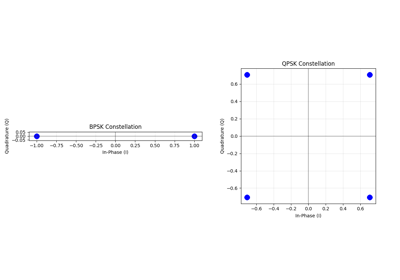
BPSK and QPSK implementation and visualization
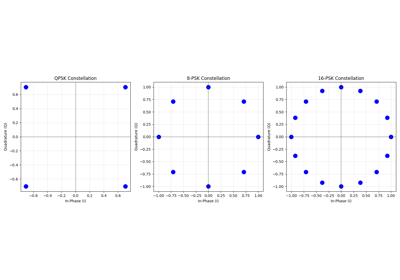
Higher-order PSK (8-PSK, 16-PSK) for increased spectral efficiency
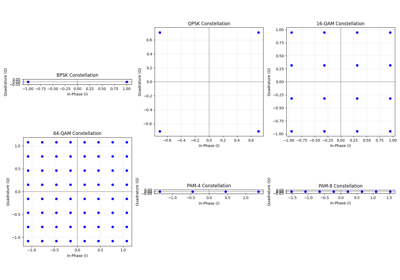
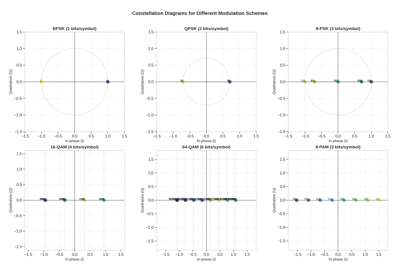
Constellation diagrams and symbol mapping
BER performance analysis across different orders
Trade-offs between spectral efficiency and error rate
QAM Modulation
The QAM examples cover different orders of Quadrature Amplitude Modulation:
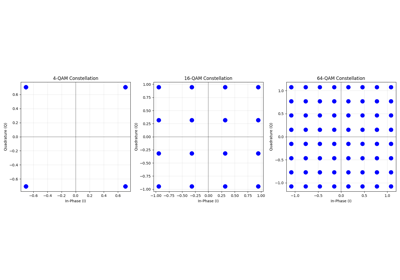
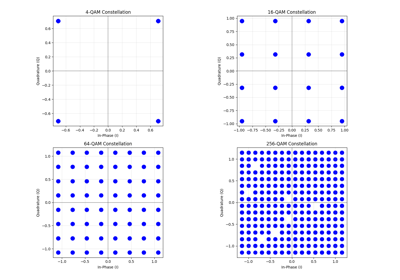
Implementation from 4-QAM up to 256-QAM
Constellation visualization and bit mapping analysis
Performance comparison across different QAM orders
Trade-offs between spectral efficiency and noise sensitivity
Real-world applications in modern communication standards
PAM Modulation
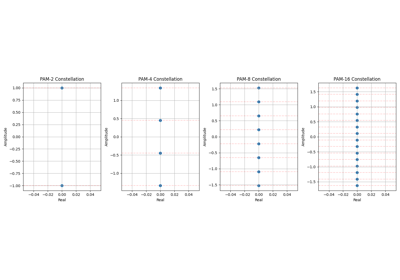
The PAM example explores Pulse Amplitude Modulation schemes:
Different PAM orders implementation
Amplitude level visualization
Symbol energy distribution analysis
BER performance characteristics
Specialized PSK Variants
These examples showcase specialized PSK variants:
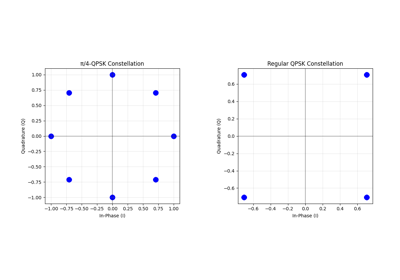
π/4-QPSK with alternating constellation rotation
Improved envelope characteristics and smoother phase transitions
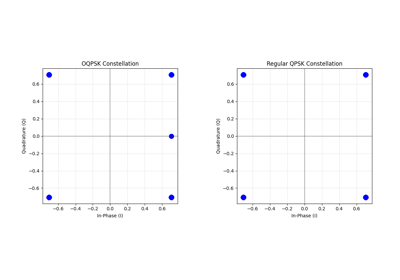
OQPSK with half-symbol delay in quadrature component
Restricted phase changes and improved stability for amplifiers
Differential Modulation
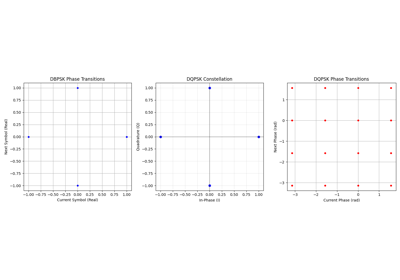
The differential modulation example showcases:
DBPSK and DQPSK implementation
Phase ambiguity tolerance
Performance in AWGN and fading channels
Phase transition visualization
Modulation Comparison
The comparison example provides:
Side-by-side analysis of different modulation schemes
Spectral efficiency comparison
Power requirement analysis
Performance trade-offs visualization
Each example includes interactive visualizations and detailed explanations, making it easy to understand the characteristics and trade-offs of different modulation schemes.