kaira.utils.CapacityAnalyzer
Inheritance diagram for CapacityAnalyzer
- class kaira.utils.CapacityAnalyzer(device: device | None = None, num_processes: int = 1, fast_mode: bool = True)[source]
Bases:
objectCompute and analyze capacity for various channels and modulation schemes.
This class provides methods to compute the Shannon capacity of continuous channels as well as the capacity and achievable rates of specific modulation schemes over various channel models. It supports both analytical calculations and Monte Carlo simulations for numerical approximations when closed-form solutions are not available.
- device
Device to run computations on (CPU or GPU)
- Type:
Methods
Initialize the capacity analyzer.
Compute Shannon capacity for an AWGN channel.
Compute Shannon capacity for a complex AWGN channel.
Compute capacity for the Binary Erasure Channel.
Compute capacity for the Binary Symmetric Channel.
Compute the cumulative distribution function (CDF) of capacity.
Compute the gap between a modulation scheme's capacity and the Shannon limit.
Compare capacity of a modulation scheme over multiple channels.
Compare capacity of multiple modulation schemes over a specified channel.
Calculate energy efficiency for a communication system.
Compute ergodic capacity for fading channels.
Compute capacity assuming Gaussian input distribution.
Compute capacity for MIMO systems.
Compute capacity of a modulation scheme over a specified channel.
Compute mutual information for a modulation scheme over a given channel.
Compute outage capacity for fading channels.
Plot capacity vs.
Plot capacity vs.
Calculate spectral efficiency for a modulation scheme.
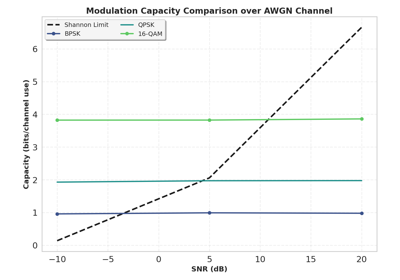
Examples using
kaira.utils.CapacityAnalyzer- __init__(device: device | None = None, num_processes: int = 1, fast_mode: bool = True)[source]
Initialize the capacity analyzer.
- Parameters:
device (torch.device, optional) – Device to run computations on. If None, uses CUDA if available, otherwise CPU.
num_processes (int, optional) – Number of parallel processes to use for Monte Carlo simulations. Default is 1 (no parallelism). Set to -1 to use all available CPU cores.
fast_mode (bool, optional) – Whether to use faster approximations
- awgn_capacity(snr_db: float | List[float] | ndarray | Tensor) Tensor[source]
Compute Shannon capacity for an AWGN channel.
Calculates C = log2(1 + SNR) for the additive white Gaussian noise channel.
- Parameters:
snr_db – Signal-to-noise ratio in dB, can be a single value or array
- Returns:
Capacity in bits per channel use
- Return type:
- awgn_capacity_complex(snr_db: float | List[float] | ndarray | Tensor) Tensor[source]
Compute Shannon capacity for a complex AWGN channel.
For complex channels, C = log2(1 + SNR) where SNR is defined per complex dimension.
- Parameters:
snr_db – Signal-to-noise ratio in dB, can be a single value or array
- Returns:
Capacity in bits per complex channel use
- Return type:
- bsc_capacity(p: float | List[float] | ndarray | Tensor) Tensor[source]
Compute capacity for the Binary Symmetric Channel.
For a BSC with crossover probability p, C = 1 - H(p) where H(p) is the binary entropy function.
- Parameters:
p – Crossover probability (0 ≤ p ≤ 0.5), can be a single value or array
- Returns:
Capacity in bits per channel use
- Return type:
- bec_capacity(erasure_prob: float | List[float] | ndarray | Tensor) Tensor[source]
Compute capacity for the Binary Erasure Channel.
For a BEC with erasure probability ε, C = 1 - ε.
- Parameters:
erasure_prob – Erasure probability (0 ≤ ε ≤ 1), can be a single value or array
- Returns:
Capacity in bits per channel use
- Return type:
- gaussian_input_capacity(channel: BaseChannel, snr_db: float | List[float] | ndarray | Tensor, constrained: bool = True) Tensor[source]
Compute capacity assuming Gaussian input distribution.
For many channels, the capacity-achieving input distribution is Gaussian. This method computes the capacity assuming a Gaussian input.
- Parameters:
channel – The channel model
snr_db – Signal-to-noise ratio in dB, can be a single value or array
constrained – Whether to apply an average power constraint
- Returns:
Capacity in bits per channel use
- Return type:
- mutual_information(modulator: BaseModulator, channel: BaseChannel, snr_db: float | List[float] | ndarray | Tensor, num_symbols: int = 10000, num_bins: int = 100, estimation_method: str = 'histogram') Tensor[source]
Compute mutual information for a modulation scheme over a given channel.
Uses Monte Carlo simulation to estimate the mutual information between channel input and output, which represents the achievable rate for a specific modulation scheme.
- Parameters:
modulator – The modulation scheme
channel – The channel model
snr_db – Signal-to-noise ratio in dB, can be a single value or array
num_symbols – Number of symbols to use in the Monte Carlo simulation
num_bins – Number of bins to use in histogram estimation
estimation_method – Method to estimate mutual information (‘histogram’ or ‘knn’)
- Returns:
Mutual information in bits per channel use
- Return type:
- modulation_capacity(modulator: BaseModulator, channel: BaseChannel, snr_db_range: List[float] | ndarray | Tensor, num_symbols: int = 10000, monte_carlo: bool = True, estimation_method: str = 'histogram') Tuple[Tensor, Tensor][source]
Compute capacity of a modulation scheme over a specified channel.
Either analytically (when possible) or using Monte Carlo simulation.
- Parameters:
modulator – The modulation scheme
channel – The channel model
snr_db_range – Range of SNR values in dB to compute capacity for
num_symbols – Number of symbols for Monte Carlo simulation
monte_carlo – Whether to force Monte Carlo simulation even if analytical solution is available
estimation_method – Method to estimate mutual information (‘histogram’ or ‘knn’)
- Returns:
(SNR values, capacity values)
- Return type:
Tuple[torch.Tensor, torch.Tensor]
- plot_capacity_vs_snr(snr_db_range: List[float] | ndarray | Tensor, capacities: List[Tensor] | Dict[str, Tensor], labels: List[str] | None = None, title: str = 'Channel Capacity vs. SNR', xlabel: str = 'SNR (dB)', ylabel: str = 'Capacity (bits/channel use)', legend_loc: str = 'lower right', include_shannon: bool = True, include_shannon_mimo: bool = False, mimo_tx: int = 2, mimo_rx: int = 2, figsize: Tuple[int, int] = (10, 6), grid: bool = True, style: str = 'default') Figure[source]
Plot capacity vs. SNR for one or more modulation schemes or channels.
- Parameters:
snr_db_range – SNR values in dB
capacities – List or dict of capacity values corresponding to each SNR point
labels – Labels for each capacity curve
title – Plot title
xlabel – X-axis label
ylabel – Y-axis label
legend_loc – Location of the legend
include_shannon – Whether to include the Shannon capacity limit
include_shannon_mimo – Whether to include the MIMO Shannon capacity limit
mimo_tx – Number of transmit antennas for MIMO capacity
mimo_rx – Number of receive antennas for MIMO capacity
figsize – Figure size (width, height) in inches
grid – Whether to show grid
style – Matplotlib style to use
- Returns:
The matplotlib figure object
- Return type:
plt.Figure
- plot_capacity_vs_param(param_values: List[float] | ndarray | Tensor, capacities: List[Tensor] | Dict[str, Tensor], param_name: str = 'Parameter', labels: List[str] | None = None, title: str = 'Channel Capacity', xlabel: str = 'Parameter Value', ylabel: str = 'Capacity (bits/channel use)', legend_loc: str = 'lower right', figsize: Tuple[int, int] = (10, 6), grid: bool = True, style: str = 'default') Figure[source]
Plot capacity vs. a parameter for one or more modulation schemes or channels.
- Parameters:
param_values – Parameter values
capacities – List or dict of capacity values corresponding to each parameter value
param_name – Name of the parameter
labels – Labels for each capacity curve
title – Plot title
xlabel – X-axis label
ylabel – Y-axis label
legend_loc – Location of the legend
figsize – Figure size (width, height) in inches
grid – Whether to show grid
style – Matplotlib style to use
- Returns:
The matplotlib figure object
- Return type:
plt.Figure
- ergodic_capacity(channel: BaseChannel, snr_db_range: List[float] | ndarray | Tensor, num_realizations: int = 1000, num_symbols_per_realization: int = 100) Tuple[Tensor, Tensor][source]
Compute ergodic capacity for fading channels.
For fading channels, the ergodic capacity is the expected value of the capacity over all fading realizations.
- Parameters:
channel – The fading channel model
snr_db_range – Range of SNR values in dB
num_realizations – Number of channel realizations to average over
num_symbols_per_realization – Number of symbols per channel realization
- Returns:
(SNR values, ergodic capacity values)
- Return type:
Tuple[torch.Tensor, torch.Tensor]
- outage_capacity(channel: BaseChannel, snr_db_range: List[float] | ndarray | Tensor, outage_probability: float = 0.01, num_realizations: int = 1000, num_symbols_per_realization: int = 100) Tuple[Tensor, Tensor][source]
Compute outage capacity for fading channels.
The outage capacity is the highest rate that can be achieved with an outage probability less than the specified value.
- Parameters:
channel – The fading channel model
snr_db_range – Range of SNR values in dB
outage_probability – Target outage probability
num_realizations – Number of channel realizations
num_symbols_per_realization – Number of symbols per channel realization
- Returns:
(SNR values, outage capacity values)
- Return type:
Tuple[torch.Tensor, torch.Tensor]
- compare_modulation_schemes(modulators: List[BaseModulator], channel: BaseChannel, snr_db_range: List[float] | ndarray | Tensor, labels: List[str] | None = None, num_symbols: int = 10000, plot: bool = True, figsize: Tuple[int, int] = (10, 6), estimation_method: str = 'histogram') Tuple[Tensor, Dict[str, Tensor], Figure | None][source]
Compare capacity of multiple modulation schemes over a specified channel.
- Parameters:
modulators – List of modulation schemes to compare
channel – The channel model
snr_db_range – Range of SNR values in dB
labels – Labels for each modulation scheme
num_symbols – Number of symbols for Monte Carlo simulation
plot – Whether to generate and return a plot
figsize – Figure size (width, height) in inches
estimation_method – Method to estimate mutual information (‘histogram’ or ‘knn’)
- Returns:
SNR values
Dictionary mapping modulation names to capacity values
Optional matplotlib figure if plot=True
- Return type:
Tuple containing
- compare_channels(modulator: BaseModulator, channels: List[BaseChannel], snr_db_range: List[float] | ndarray | Tensor, labels: List[str] | None = None, num_symbols: int = 10000, plot: bool = True, figsize: Tuple[int, int] = (10, 6), estimation_method: str = 'histogram') Tuple[Tensor, Dict[str, Tensor], Figure | None][source]
Compare capacity of a modulation scheme over multiple channels.
- Parameters:
modulator – The modulation scheme
channels – List of channel models to compare
snr_db_range – Range of SNR values in dB
labels – Labels for each channel
num_symbols – Number of symbols for Monte Carlo simulation
plot – Whether to generate and return a plot
figsize – Figure size (width, height) in inches
estimation_method – Method to estimate mutual information (‘histogram’ or ‘knn’)
- Returns:
SNR values
Dictionary mapping channel names to capacity values
Optional matplotlib figure if plot=True
- Return type:
Tuple containing
- mimo_capacity(snr_db_range: float | List[float] | ndarray | Tensor, tx_antennas: int = 2, rx_antennas: int = 2, channel_knowledge: str = 'perfect', num_realizations: int = 1000) Tensor[source]
Compute capacity for MIMO systems.
For MIMO systems, the capacity varies based on channel knowledge at the transmitter.
- Parameters:
snr_db_range – Range of SNR values in dB
tx_antennas – Number of transmit antennas
rx_antennas – Number of receive antennas
channel_knowledge – Type of channel knowledge (‘perfect’, ‘statistical’, ‘none’)
num_realizations – Number of channel realizations to average over
- Returns:
MIMO capacity in bits per channel use
- Return type:
- capacity_gap_to_shannon(modulator: BaseModulator, channel: BaseChannel, snr_db_range: List[float] | ndarray | Tensor, num_symbols: int = 10000) Tuple[Tensor, Tensor][source]
Compute the gap between a modulation scheme’s capacity and the Shannon limit.
This quantifies how close a practical modulation scheme comes to the theoretical limit.
- Parameters:
modulator – The modulation scheme
channel – The channel model
snr_db_range – Range of SNR values in dB
num_symbols – Number of symbols for Monte Carlo simulation
- Returns:
(SNR values, capacity gap in dB)
- Return type:
Tuple[torch.Tensor, torch.Tensor]
- capacity_cdf(channel: BaseChannel, snr_db: float, num_realizations: int = 10000) Tuple[Tensor, Tensor][source]
Compute the cumulative distribution function (CDF) of capacity.
For fading channels, this shows the probability that capacity is less than a certain value.
- Parameters:
channel – The channel model (should be a fading channel)
snr_db – Signal-to-noise ratio in dB
num_realizations – Number of channel realizations
- Returns:
(Capacity values, CDF values)
- Return type:
Tuple[torch.Tensor, torch.Tensor]
- spectral_efficiency(modulator: BaseModulator, channel: BaseChannel, snr_db_range: List[float] | ndarray | Tensor, bandwidth: float = 1.0, overhead: float = 0.0) Tuple[Tensor, Tensor][source]
Calculate spectral efficiency for a modulation scheme.
Takes into account protocol overhead to give a realistic measure of efficiency.
- Parameters:
modulator – The modulation scheme
channel – The channel model
snr_db_range – Range of SNR values in dB
bandwidth – Signal bandwidth in Hz
overhead – Fraction of overhead (0 to 1) for protocols, pilots, etc.
- Returns:
(SNR values, spectral efficiency in bits/s/Hz)
- Return type:
Tuple[torch.Tensor, torch.Tensor]
- energy_efficiency(modulator: BaseModulator, channel: BaseChannel, snr_db_range: List[float] | ndarray | Tensor, tx_power_watts: float = 1.0, circuit_power_watts: float = 0.1) Tuple[Tensor, Tensor][source]
Calculate energy efficiency for a communication system.
Energy efficiency is defined as bits/joule, accounting for both transmission power and circuit power consumption.
- Parameters:
modulator – The modulation scheme
channel – The channel model
snr_db_range – Range of SNR values in dB
tx_power_watts – Transmission power in watts
circuit_power_watts – Circuit power consumption in watts
- Returns:
(SNR values, energy efficiency in bits/joule)
- Return type:
Tuple[torch.Tensor, torch.Tensor]