kaira.models.fec.encoders.BaseBlockCodeEncoder
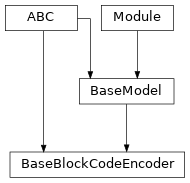
Inheritance diagram for BaseBlockCodeEncoder
- class kaira.models.fec.encoders.BaseBlockCodeEncoder(code_length: int, code_dimension: int, *args: Any, **kwargs: Any)[source]
-
Base class for block code encoders.
This abstract class provides a common interface and functionality for all types of block code encoders. It serves as a foundation for specific implementations like linear block codes, cyclic codes, BCH codes, etc.
Block codes transform k information bits into n coded bits (n > k), providing error detection and correction capabilities. The redundancy added during encoding enables the receiver to detect and possibly correct errors introduced by the channel.
- Parameters:
- Raises:
ValueError – If code parameters are invalid (e.g., non-positive or dimension > length)
Note
All concrete implementations must override the forward, inverse_encode, and calculate_syndrome methods to provide specific encoding and decoding behavior.
Methods
Initialize the block code encoder with specified parameters.
Calculate the syndrome of a received codeword.
Extract the message bits from a codeword.
Apply the encoding operation to the input tensor.
Decode a received codeword back to a message.
Attributes
Get the code dimension (k).
Get the codeword length (n).
Get the rate of the code (k/n).
Get the number of parity bits (synonym for redundancy).
Get the code redundancy (r = n - k).
Examples using
kaira.models.fec.encoders.BaseBlockCodeEncoder- __init__(code_length: int, code_dimension: int, *args: Any, **kwargs: Any)[source]
Initialize the block code encoder with specified parameters.
Sets up the basic code parameters and validates that they meet the requirements for a valid block code (positive length, positive dimension, dimension <= length).
- property code_length: int
Get the codeword length (n).
- Returns:
The number of bits in each codeword after encoding
- property code_dimension: int
Get the code dimension (k).
- Returns:
The number of information bits encoded in each codeword
- property redundancy: int
Get the code redundancy (r = n - k).
- Returns:
The number of redundant bits added during encoding
- property parity_bits: int
Get the number of parity bits (synonym for redundancy).
- Returns:
The number of parity/check bits in each codeword
- property code_rate: float
Get the rate of the code (k/n).
The code rate is a measure of efficiency, representing the proportion of the total bits that carry information (as opposed to redundancy).
- Returns:
The ratio of information bits to total bits (between 0 and 1)
- extract_message(codeword: Tensor) Tensor[source]
Extract the message bits from a codeword.
By default, this calls inverse_encode and returns just the decoded message. Subclasses can override this method to provide more efficient implementations.
- Parameters:
codeword – Codeword tensor with shape (…, n) where n is the code length
- Returns:
Extracted message tensor with shape (…, k) where k is the code dimension
Note
This implementation assumes the inverse_encode method can handle a single codeword correctly. Specific code types may override this with more efficient implementations.
- abstract forward(x: Tensor, *args: Any, **kwargs: Any) Tensor[source]
Apply the encoding operation to the input tensor.
Transforms message bits into codewords by adding redundancy according to the specific encoding scheme implemented by the subclass.
- Parameters:
x – Input tensor containing message bits. The last dimension should be a multiple of the code dimension (k).
*args – Additional positional arguments for specific encoder implementations.
**kwargs – Additional keyword arguments for specific encoder implementations.
- Returns:
Encoded tensor with codewords. Has the same shape as the input except the last dimension is expanded by a factor of n/k.
- Raises:
ValueError – If the last dimension of x is not a multiple of k.
Note
The specific encoding method depends on the subclass implementation. For example, linear codes use matrix multiplication, while other codes may use different algorithms.
- abstract inverse_encode(x: Tensor, *args: Any, **kwargs: Any) Tensor | Tuple[Tensor, Tensor][source]
Decode a received codeword back to a message.
This method is the inverse of the encoding process, attempting to recover the original message from a potentially corrupted codeword. The ability to correct errors depends on the specific code properties and the error pattern.
- Parameters:
x – Input tensor containing received codewords. The last dimension should be a multiple of the code length (n).
*args – Additional positional arguments for specific decoder implementations.
**kwargs – Additional keyword arguments for specific decoder implementations.
- Returns:
Decoded tensor containing messages, or
A tuple of (decoded tensor, syndrome or error information)
The return type depends on the specific implementation and parameters.
- Return type:
Either
- Raises:
ValueError – If the last dimension of x is not a multiple of n.
Note
This method may not recover the original message perfectly if the number of errors exceeds the error-correcting capability of the code.
- abstract calculate_syndrome(x: Tensor) Tensor[source]
Calculate the syndrome of a received codeword.
The syndrome provides information about errors that may have occurred during transmission. A zero syndrome indicates that the received word is a valid codeword (though not necessarily the transmitted one if the number of errors is large).
The syndrome pattern helps identify the error pattern and is used in the decoding process to correct errors.
- Parameters:
x – Received codeword tensor with shape (…, n) or (…, m*n) where n is the code length and m is some multiple.
- Returns:
Syndrome tensor that characterizes the error pattern (if any). A zero syndrome indicates a valid codeword.
Note
For linear codes, the syndrome is computed as H·r where H is the parity-check matrix and r is the received codeword vector.